
The world of technology has been increasingly driven by two powerful forces: Artificial Intelligence (AI) and Machine Learning (ML). These concepts have become synonymous with advancements in data science and automation, yet they are often misunderstood or conflated. This article delves deep into the nuances between AI and ML, their applications across industries, and the implications of these technologies for professionals working within tech development.
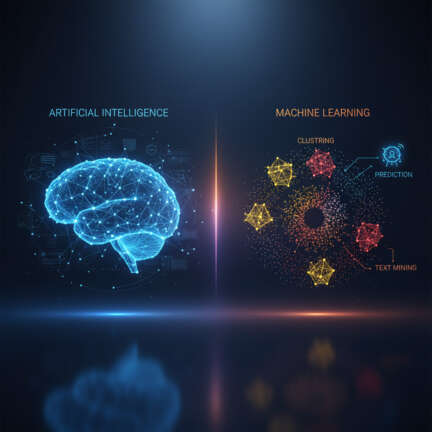
Artificial Intelligence encompasses a broad set of techniques used to create intelligent machines that can perform tasks requiring human intelligence, such as visual perception, speech recognition, decision-making, and language translation. Machine Learning is one subset of AI, focusing specifically on algorithms that allow computers to learn from data without being explicitly programmed.
Understanding the Basics: Artificial Intelligence vs. Machine Learning
Artificial Intelligence (AI) refers to a broader concept that aims at creating intelligent machines capable of performing tasks that typically require human intelligence. This includes capabilities such as learning, reasoning, problem-solving, perception, understanding language, planning, and more. AI can be seen as the overarching field which encompasses various technologies designed to mimic or enhance human cognitive functions.
Machine Learning (ML), on the other hand, is a specific subset of AI that focuses on designing algorithms allowing machines to learn patterns from data without being explicitly programmed. ML uses statistical techniques to enable computer systems to improve at tasks with experience over time by learning from examples, rather than following static programming rules.
Differences in Approach and Application
One key difference lies in the approach each takes towards achieving intelligent behavior. While AI aims to replicate or enhance human intelligence through various methods including rule-based systems, expert systems, and more recently neural networks and deep learning models, ML focuses primarily on developing algorithms that allow computers to learn from data autonomously.
In practical applications, this distinction translates into different use cases for each technology. For example, an AI system might analyze medical images to diagnose diseases by mimicking a radiologist’s decision-making process using pre-programmed rules and heuristics. Conversely, ML techniques could be used in the same scenario where the model learns from thousands of labeled medical image datasets to predict outcomes without being explicitly told how to do so.
The Evolution of Machine Learning: From Classic Algorithms to Modern Models
Machine learning has come a long way since its inception. Early ML models relied on classic algorithms such as decision trees, support vector machines (SVMs), and ensemble methods like random forests. These foundational techniques laid the groundwork for more advanced developments in recent years.
Today’s landscape is dominated by deep learning models, which are multi-layer neural networks capable of handling large datasets and complex patterns. Deep learning has revolutionized fields such as computer vision and natural language processing (NLP) due to its ability to automatically extract features from raw data through multiple layers of abstraction.
Applications Across Industries
The impact of ML extends far beyond just these two areas, influencing diverse industries including healthcare, finance, automotive, retail, and more. In healthcare, for instance, deep learning models are being employed to analyze medical images with unprecedented accuracy, aiding in early diagnosis and personalized treatment plans.
In finance, machine learning algorithms power fraud detection systems that can identify suspicious activities by analyzing transaction patterns over time. Retailers leverage ML techniques to predict consumer behavior based on past purchasing trends, optimizing inventory management and marketing strategies accordingly.
Challenges and Ethical Considerations in AI & Machine Learning
The rapid advancements in AI and ML have brought about significant challenges as well as ethical considerations. One major issue is the potential for bias in algorithmic decision-making processes, especially when models are trained on imbalanced or biased datasets.
Another challenge lies in ensuring transparency and interpretability of complex deep learning models. As these systems become increasingly sophisticated, it becomes harder to understand how they arrive at certain decisions, making accountability a pressing concern.
The Role of Human Oversight
In light of these challenges, maintaining human oversight remains crucial for ethical deployment of AI and ML technologies. This includes establishing clear guidelines around data privacy, security measures against malicious attacks, and continuous monitoring to ensure fairness in automated decision-making processes.
Moreover, fostering interdisciplinary collaboration between technologists, ethicists, policymakers, and end-users is essential for building trust and promoting responsible innovation. By integrating diverse perspectives early on, we can develop more robust frameworks that align with societal values while maximizing technological benefits.
The Future of AI & Machine Learning
Looking ahead, the future seems bright but also complex as new frontiers continue to emerge in this space. Areas like explainable AI (XAI), quantum computing, and hybrid models combining traditional ML approaches with cutting-edge techniques promise exciting developments.
As these technologies evolve, it will be crucial for professionals working within tech development to stay informed about the latest trends while also considering broader implications beyond technical capabilities alone. By doing so, we can ensure that AI and machine learning contribute positively towards solving real-world problems across various domains.
Tl;Dr
In summary, understanding the difference between artificial intelligence and machine learning is crucial for anyone working in tech or data science today. While AI encompasses a wide range of techniques aimed at creating intelligent machines, ML focuses specifically on algorithms enabling computers to learn from data autonomously.
From classic algorithms to deep learning models, machine learning has transformed how we approach complex problems across industries such as healthcare, finance, and retail. However, it also presents challenges related to bias, transparency, and ethical deployment which require careful consideration moving forward.