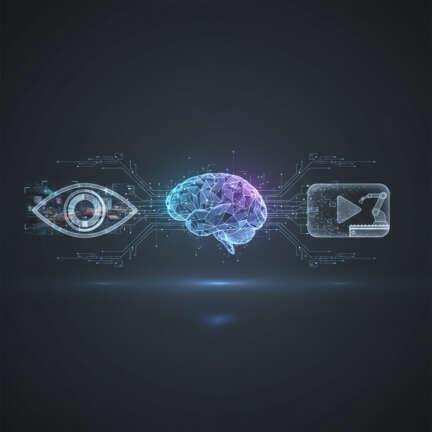

In the rapidly evolving world of artificial intelligence (AI), one of the most fascinating and transformative fields is computer vision. This technology enables machines to interpret and make decisions based on visual input from the world, much like human vision. From recognizing objects in images to understanding complex scenes in videos, computer vision is revolutionizing industries ranging from healthcare to automotive.
But what exactly is computer vision, and how does it work? In this article, we’ll delve into the fundamentals of computer vision, explore its key applications, and discuss the technologies that make it possible. Whether you’re a tech professional or simply curious about AI, this guide will provide you with a comprehensive understanding of computer vision and its potential.
What is Computer Vision?
Computer vision is a field of AI that trains computers to interpret and make decisions based on visual data from the world. This involves understanding digital images and videos to perform tasks such as object recognition, facial recognition, and image processing. Essentially, computer vision aims to replicate the human visual system, enabling machines to ‘see’ and understand their environment.
According to azure.microsoft.com, computer vision involves acquiring, processing, analyzing, and understanding digital images to extract meaningful information. This process can be broken down into several key steps, including image acquisition, preprocessing, feature extraction, and decision-making. Each of these steps plays a crucial role in enabling machines to interpret visual data accurately.
Key Components of Computer Vision
The field of computer vision encompasses a variety of techniques and technologies. Some of the key components include:
- Image Processing: This involves manipulating images to improve their quality or extract specific information. Techniques such as noise reduction, contrast enhancement, and image segmentation are commonly used.
- Object Recognition: This is the ability of a machine to identify and classify objects within an image. For example, a computer vision system might be trained to recognize different types of animals or vehicles.
- Facial Recognition: This involves identifying or verifying individuals based on their facial features. Facial recognition is widely used in security systems and personal devices.
- Video Analysis: This includes analyzing video data to detect and track objects, recognize activities, and understand scenes. Video analysis is crucial for applications such as surveillance and autonomous vehicles.
How Computer Vision Works
Computer vision systems rely on a combination of hardware and software to interpret visual data. The process typically begins with image acquisition, where images or videos are captured using cameras or other sensors. These images are then preprocessed to enhance their quality and prepare them for analysis.
Once the images are preprocessed, feature extraction techniques are applied to identify key characteristics within the images. These features can include edges, textures, and shapes, which are used to distinguish between different objects. Machine learning algorithms, particularly deep learning models, are often employed to analyze these features and make decisions based on the visual data.
According to ibm.com, deep learning models, such as convolutional neural networks (CNNs), are particularly effective for computer vision tasks. These models can learn to recognize complex patterns within images, enabling them to perform tasks such as object detection and image classification with high accuracy.
Applications of Computer Vision
Computer vision has a wide range of applications across various industries. Some of the most notable applications include:
- Healthcare: Computer vision is used to analyze medical images, such as X-rays and MRIs, to detect diseases and assist in diagnosis. This can significantly improve the accuracy and efficiency of medical treatments.
- Automotive: Autonomous vehicles rely on computer vision to navigate roads, detect obstacles, and make driving decisions. This technology is crucial for the development of self-driving cars.
- Security: Facial recognition and video analysis are widely used in security systems to monitor and identify individuals. This can help prevent crime and enhance public safety.
- Retail: Computer vision is used to analyze customer behavior, optimize store layouts, and improve inventory management. This can lead to better customer experiences and increased sales.
Challenges and Future Directions
While computer vision has made significant advancements, it still faces several challenges. One of the main challenges is the need for large amounts of labeled data to train machine learning models. Collecting and annotating this data can be time-consuming and expensive.
Another challenge is the ability to generalize across different environments and conditions. Computer vision systems must be able to perform accurately in various lighting conditions, angles, and backgrounds. Additionally, ensuring the privacy and security of visual data is crucial, especially in applications such as facial recognition.
According to builtin.com, future directions in computer vision include the development of more robust and adaptable models, the integration of computer vision with other AI technologies, and the exploration of new applications in fields such as agriculture and manufacturing.
Ethical Considerations
As computer vision becomes more prevalent, ethical considerations become increasingly important. Issues such as bias in algorithms, privacy concerns, and the potential for misuse must be addressed. Developers and researchers must prioritize ethical guidelines and responsible AI practices to ensure that computer vision is used for the benefit of society.
TL;DR
Computer vision is a transformative field of AI that enables machines to interpret and make decisions based on visual data. Key components include image processing, object recognition, facial recognition, and video analysis. Computer vision systems rely on a combination of hardware and software, with deep learning models playing a crucial role in analyzing visual data. Applications of computer vision span industries such as healthcare, automotive, security, and retail. Challenges include the need for large amounts of labeled data, generalization across different environments, and ethical considerations. Future directions involve the development of more robust models and the exploration of new applications. By understanding the fundamentals of computer vision, we can appreciate its potential to revolutionize various aspects of our lives.