
In the rapidly evolving world of technology, two terms that often spark curiosity and debate are Artificial Intelligence (AI) and Machine Learning (ML). While they are frequently used interchangeably, they represent distinct concepts with unique capabilities and applications. Understanding the nuances between AI and ML is crucial for tech professionals and students eager to harness their potential. This article delves into the fundamentals of AI and ML, their interplay, and their transformative impact on various industries.
AI encompasses a broader spectrum of technologies aimed at creating systems that can perform tasks typically requiring human intelligence. These tasks include reasoning, learning, problem-solving, perception, and language understanding. On the other hand, ML is a subset of AI that focuses on developing algorithms and statistical models enabling computers to learn from data without being explicitly programmed. The synergy between AI and ML is driving innovation, automating processes, and unlocking new possibilities in fields such as healthcare, finance, and transportation.
Understanding Artificial Intelligence
Artificial Intelligence refers to the simulation of human intelligence processes by machines, especially computer systems. These processes include learning, reasoning, problem-solving, perception, and language understanding. AI can be categorized into two main types: narrow AI and general AI. Narrow AI is designed to perform a narrow task, such as facial recognition or internet searches, while general AI aims to perform any intellectual task that a human can do.
The history of AI dates back to the 1950s, with significant milestones including the development of the first AI program, the Turing Test, and the advent of expert systems. Today, AI is integrated into various applications, from virtual assistants like Siri and Alexa to autonomous vehicles and fraud detection systems. The goal of AI is to create systems that can perceive their environment and take actions to achieve a specific goal, much like humans do.
The Role of AI in Data Analysis
AI plays a pivotal role in data analysis by enabling the processing and interpretation of vast amounts of data. AI algorithms can identify patterns, make predictions, and provide insights that would be impossible for humans to discern manually. For instance, AI-powered analytics tools can analyze customer behavior, optimize supply chains, and predict equipment failures, leading to more informed decision-making and improved operational efficiency.
One of the key advantages of AI in data analysis is its ability to handle unstructured data, such as images, videos, and text. Traditional data analysis methods struggle with unstructured data, but AI algorithms excel at extracting meaningful information from these sources. This capability is particularly valuable in fields like healthcare, where AI can analyze medical images to detect diseases or interpret electronic health records to identify trends and patterns.
Exploring Machine Learning
Machine Learning is a subset of AI that focuses on developing algorithms and statistical models that enable computers to learn from data. Unlike traditional programming, where a developer writes explicit instructions for the computer to follow, ML algorithms build models based on data, allowing them to make predictions or decisions without being explicitly programmed. This ability to learn and adapt makes ML a powerful tool for solving complex problems.
ML algorithms can be broadly categorized into three types: supervised learning, unsupervised learning, and reinforcement learning. Supervised learning involves training a model on a labeled dataset, where the correct answers are known. Unsupervised learning, on the other hand, involves training a model on an unlabeled dataset, where the model must identify patterns and relationships on its own. Reinforcement learning involves training a model through trial and error, where the model receives feedback in the form of rewards or penalties.
The Importance of ML Algorithms
ML algorithms are the backbone of many AI applications, enabling systems to learn from data and make accurate predictions. These algorithms are used in a wide range of applications, from recommendation systems and fraud detection to autonomous vehicles and natural language processing. The effectiveness of ML algorithms depends on the quality and quantity of the data they are trained on, as well as the choice of algorithm and the tuning of hyperparameters.
One of the key challenges in ML is the need for large amounts of high-quality data. The performance of ML models is directly proportional to the quality of the data they are trained on. Poor-quality data can lead to inaccurate predictions and unreliable results. Therefore, data preprocessing and feature engineering are crucial steps in the ML pipeline, ensuring that the data is clean, relevant, and ready for analysis.
The Synergy Between AI and ML
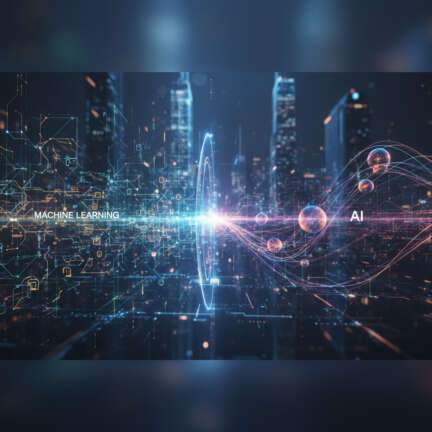
While AI and ML are distinct concepts, they are deeply interconnected and often used together to create intelligent systems. AI provides the framework for creating systems that can perform tasks requiring human intelligence, while ML provides the algorithms and models that enable these systems to learn from data. The synergy between AI and ML is driving innovation and transforming industries by automating processes, improving efficiency, and unlocking new insights.
The interplay between AI and ML is evident in various applications, from virtual assistants and autonomous vehicles to fraud detection and personalized marketing. For example, virtual assistants like Siri and Alexa use AI to understand and respond to user queries, while ML algorithms enable them to learn from user interactions and improve their performance over time. Similarly, autonomous vehicles use AI to perceive their environment and make decisions, while ML algorithms enable them to learn from driving data and improve their safety and efficiency.
Applications of AI and ML
The applications of AI and ML are vast and diverse, spanning industries such as healthcare, finance, transportation, and retail. In healthcare, AI and ML are used to analyze medical images, predict disease outbreaks, and personalize treatment plans. In finance, they are used to detect fraud, assess credit risk, and optimize investment portfolios. In transportation, they are used to optimize routes, improve traffic management, and develop autonomous vehicles. In retail, they are used to personalize marketing campaigns, optimize inventory management, and enhance customer experiences.
The potential of AI and ML is limited only by the imagination and creativity of those who develop and deploy them. As technology continues to evolve, so too will the applications of AI and ML, opening up new possibilities and transforming the way we live and work. To stay ahead of the curve, tech professionals and students must continuously update their knowledge and skills, keeping pace with the latest advancements and trends in AI and ML.
The Future of AI and ML
The future of AI and ML is bright and promising, with continued advancements and innovations on the horizon. Emerging technologies such as deep learning, reinforcement learning, and explainable AI are pushing the boundaries of what is possible, enabling more accurate predictions, better decision-making, and improved performance. As AI and ML continue to evolve, they will play an increasingly important role in shaping the future of technology and society.
One of the key trends in AI and ML is the shift towards explainable AI, which aims to make AI systems more transparent and understandable. Explainable AI seeks to provide insights into how AI systems make decisions, enabling users to trust and rely on them. This trend is particularly important in fields such as healthcare and finance, where the stakes are high, and the consequences of incorrect decisions can be severe.
Another key trend is the integration of AI and ML with other emerging technologies, such as the Internet of Things (IoT), blockchain, and quantum computing. The combination of these technologies is creating new opportunities and unlocking new possibilities, from smart cities and autonomous supply chains to secure and decentralized systems. As these technologies continue to evolve, they will drive innovation and transformation, shaping the future of AI and ML.
TL;DR
Artificial Intelligence (AI) and Machine Learning (ML) are transformative technologies that are reshaping industries and driving innovation. AI encompasses a broader spectrum of technologies aimed at creating systems that can perform tasks requiring human intelligence, while ML focuses on developing algorithms and statistical models that enable computers to learn from data. The synergy between AI and ML is driving advancements in data analysis, pattern recognition, and inference, leading to more informed decision-making and improved operational efficiency.
The future of AI and ML is bright, with continued advancements and innovations on the horizon. Emerging technologies such as deep learning, reinforcement learning, and explainable AI are pushing the boundaries of what is possible, enabling more accurate predictions, better decision-making, and improved performance. To stay ahead of the curve, tech professionals and students must continuously update their knowledge and skills, keeping pace with the latest advancements and trends in AI and ML.
For further reading, explore the following sources: cloud.google.com, sas.com, and sciencedirect.com.