
Artificial Intelligence (AI) and Machine Learning (ML) are transforming industries, enabling predictive models, and revolutionizing data science. These technologies are not just buzzwords; they are powerful tools that researchers, developers, and students use to solve complex problems. Whether you’re new to the field or looking to deepen your understanding, this guide will provide a comprehensive overview of AI and machine learning, their applications, and the key differences between them.
From supervised and unsupervised learning to deep learning, we’ll explore the various types of machine learning algorithms and their real-world applications. By the end of this article, you’ll have a solid foundation in AI and machine learning concepts, enabling you to apply these technologies in your research or development projects.
Understanding AI and Machine Learning
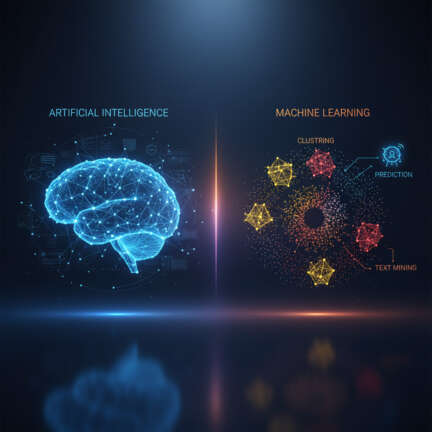
AI refers to the simulation of human intelligence in machines that are programmed to think and learn. These intelligent systems can perform tasks such as visual perception, speech recognition, decision-making, and language translation. On the other hand, machine learning is a subset of AI that focuses on the development of algorithms that allow computers to learn from data without being explicitly programmed.
According to cloud.google.com, AI is the broader concept of machines being able to carry out tasks in a way that we would consider “smart.” Machine learning is a current application of AI based around the idea that we should be able to give machines access to data and let them learn for themselves.
Types of Machine Learning
Machine learning can be broadly categorized into three types: supervised learning, unsupervised learning, and reinforcement learning. Each type has its unique applications and methods of training algorithms.
Supervised Learning
Supervised learning involves training algorithms on a labeled dataset. This means that the input data is paired with the desired output, allowing the algorithm to learn the mapping from input to output. Common applications of supervised learning include classification and regression tasks.
For example, in a classification task, the algorithm might be trained to recognize handwritten digits. The labeled dataset would consist of images of handwritten digits along with their corresponding labels (0-9). The algorithm learns to map the input images to the correct labels.
Unsupervised Learning
Unsupervised learning involves training algorithms on an unlabeled dataset. The algorithm must identify patterns and relationships within the data without being given explicit instructions. Common applications of unsupervised learning include clustering and association tasks.
For instance, in a clustering task, the algorithm might be given a dataset of customer purchase histories. The algorithm would group customers into segments based on similar purchase patterns, allowing businesses to target specific customer groups more effectively.
Reinforcement Learning
Reinforcement learning involves training algorithms through a system of rewards and punishments. The algorithm learns to make decisions by receiving feedback in the form of rewards for correct actions and punishments for incorrect actions. Common applications of reinforcement learning include game playing and robotics.
An example of reinforcement learning is training an algorithm to play a game like chess. The algorithm learns by playing multiple games, receiving rewards for winning and punishments for losing. Over time, the algorithm improves its strategy and performance.
Deep Learning: The Future of AI
Deep learning is a subset of machine learning that uses neural networks with many layers to model complex patterns in data. These deep neural networks can learn hierarchical representations of data, making them particularly effective for tasks such as image and speech recognition.
According to sas.com, deep learning algorithms are inspired by the structure and function of the brain, allowing them to process vast amounts of data and make accurate predictions.
For example, deep learning algorithms have been used to develop self-driving cars. These algorithms can process data from sensors and cameras to make real-time decisions about steering, braking, and accelerating.
Applications of AI and Machine Learning
AI and machine learning have a wide range of applications across various industries. From healthcare to finance, these technologies are being used to solve complex problems and improve efficiency.
Healthcare
In healthcare, AI and machine learning are used for diagnostic imaging, drug discovery, and personalized treatment plans. For example, algorithms can analyze medical images to detect diseases such as cancer at an early stage, improving patient outcomes.
According to ibm.com, machine learning algorithms can analyze vast amounts of medical data to identify patterns and make predictions, enabling healthcare providers to make more informed decisions.
Finance
In the finance industry, AI and machine learning are used for fraud detection, risk management, and algorithmic trading. For example, algorithms can analyze transaction data to identify fraudulent activities in real-time, preventing financial losses.
Machine learning algorithms can also analyze market data to make predictions about stock prices, enabling traders to make more informed investment decisions.
Challenges and Future Directions
While AI and machine learning have made significant advancements, there are still challenges to be addressed. Issues such as data privacy, bias in algorithms, and the need for more interpretable models are areas of ongoing research.
According to developers.google.com, the future of AI and machine learning lies in developing more robust and ethical algorithms that can handle complex, real-world problems.
Researchers and developers are also exploring new techniques such as explainable AI, which aims to make machine learning models more transparent and understandable. This is particularly important in fields such as healthcare, where understanding the reasoning behind a model’s predictions is crucial.
TL;DR
In summary, AI and machine learning are powerful technologies that are transforming industries and solving complex problems. Understanding the different types of machine learning, such as supervised, unsupervised, and reinforcement learning, is essential for researchers and developers. Deep learning, a subset of machine learning, is particularly effective for tasks such as image and speech recognition. Applications of AI and machine learning span various industries, including healthcare and finance. While challenges such as data privacy and bias in algorithms remain, the future of AI and machine learning looks promising with ongoing research and development in areas like explainable AI.