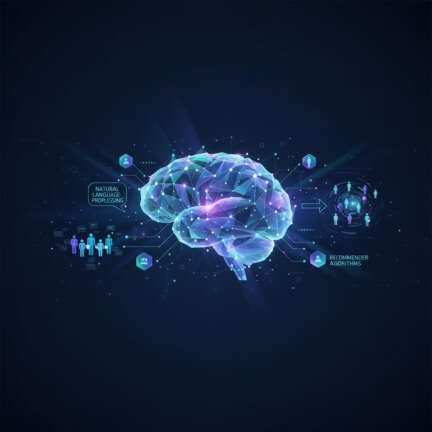

Artificial intelligence (AI) has come a long way since the term was first coined over half a century ago. Today, one of the most exciting branches within AI is deep learning—a subset of machine learning that relies on neural networks to process large amounts of data and extract meaningful patterns and insights.
The concept behind deep learning revolves around simulating how human brains work by using artificial neural networks. These networks are designed to mimic the way neurons interact in biological systems, allowing them to learn from vast datasets with minimal human intervention. This has led to significant advancements in various fields such as natural language processing (NLP), computer vision, and speech recognition.
As technology continues to evolve at an unprecedented pace, understanding deep learning becomes increasingly crucial for tech professionals looking to stay ahead of the curve. In this article, we will explore what deep learning is all about, its applications in real-world scenarios, challenges it faces, and future trends that are shaping the landscape of AI.
Understanding Deep Learning
To truly grasp the power of deep learning, one must first understand how neural networks function. At their core, these networks consist of layers of interconnected nodes or neurons arranged in an input layer, hidden layers, and output layer. Information flows through these layers as inputs are processed and transformed into outputs.
Each node within a network receives information from other nodes, processes it using weights assigned to connections between them, and passes the result on to subsequent nodes until reaching the final output stage. This process allows deep learning models to learn complex representations of data through multiple layers, enabling them to capture intricate relationships that would be difficult for traditional algorithms to detect.
One key aspect setting deep learning apart from conventional machine learning techniques lies in its ability to automatically extract features relevant to specific tasks without manual feature engineering. By leveraging large volumes of labeled training examples, these models can identify patterns and make predictions with remarkable accuracy across various domains including image classification, speech recognition, and language translation.
Neural Network Architectures
Several types of neural network architectures have emerged as popular choices for deep learning tasks. Convolutional Neural Networks (CNNs) excel at handling spatial hierarchies present in images, making them indispensable for computer vision applications like object detection and image segmentation.
Recurrent Neural Networks (RNNs), on the other hand, are well-suited for sequential data processing where temporal dependencies play a critical role. They maintain internal memory states allowing information to persist over time, which makes RNNs highly effective in natural language understanding tasks such as sentiment analysis and text generation.
Lastly, Generative Adversarial Networks (GANs) represent an innovative approach by pitting two neural networks against each other – a generator network tasked with producing realistic samples while a discriminator network aims to distinguish these from actual examples. Through this adversarial training process, GANs can create highly detailed and contextually accurate synthetic data sets.
Applications of Deep Learning
The impact of deep learning extends far beyond just improving traditional machine learning models; it has revolutionized entire industries by enabling sophisticated solutions to previously unsolvable problems. For instance, in healthcare, deep learning algorithms can analyze medical images with greater precision than human radiologists when detecting early signs of diseases like cancer.
Another area witnessing remarkable progress thanks to deep learning is autonomous driving technology. Self-driving cars utilize advanced sensors and cameras coupled with powerful onboard computers running sophisticated deep neural networks capable of real-time object recognition, path planning, and decision making under dynamic traffic conditions.
In addition to these high-profile use cases, deep learning also plays a vital role in enhancing user experiences on digital platforms through intelligent recommendation systems. E-commerce websites leverage collaborative filtering techniques powered by deep learning models to suggest products tailored specifically towards individual customer preferences based on purchase history and browsing behavior.
Challenges and Limitations
Despite its numerous advantages, there are still several challenges that need addressing before deep learning can be fully integrated into mainstream applications. One major concern revolves around interpretability issues arising from the complexity inherent in deep neural networks. With millions or even billions of parameters involved, understanding exactly how these models arrive at certain decisions remains challenging.
Moreover, training deep learning models requires substantial computational resources and time investment due to their data-intensive nature. High-performance GPUs equipped with specialized hardware accelerators like Tensor Processing Units (TPUs) have become essential tools for efficient model development but remain out of reach for many organizations lacking sufficient budget or infrastructure support.
Data privacy concerns also pose significant barriers towards widespread adoption since deep learning models often rely heavily on large datasets containing sensitive personal information such as medical records and financial transactions. Ensuring adequate safeguards while maintaining transparency regarding data usage practices is crucial to building trust among end-users who may be hesitant about sharing their private details.
Future Trends in Deep Learning
The rapid pace of innovation within the field suggests that deep learning will continue evolving over coming years. Quantum computing represents one promising avenue for accelerating training times and improving model performance by harnessing the unique properties associated with quantum bits (qubits).
Transfer learning, another emerging trend, aims to leverage pre-trained models across different domains rather than starting from scratch every time a new task arises. This approach not only speeds up development cycles but also enables better generalization capabilities across diverse contexts.
Lastly, advancements in Explainable AI (XAI) methodologies hold great potential for enhancing transparency within deep learning systems by providing clear explanations behind their decision-making processes. As society becomes more reliant on automated intelligent agents, ensuring accountability and ethical standards will become paramount considerations shaping future developments.
Tl;dr
In summary, deep learning stands at the forefront of modern artificial intelligence research, offering unparalleled opportunities for solving complex problems involving massive datasets. From healthcare diagnostics to autonomous vehicles and personalized recommendations, its impact spans numerous industries with immense potential yet untapped.
However, it’s important to recognize both strengths and weaknesses associated with this powerful technique so that we can harness its benefits responsibly while mitigating risks along the way. As technology continues advancing at breakneck speed, staying informed about latest breakthroughs remains essential for anyone interested in staying ahead of curve within world of AI.