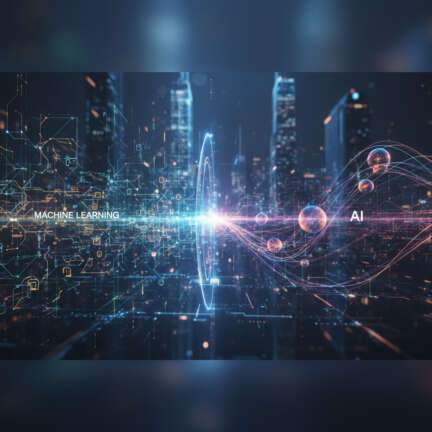

The terms artificial intelligence (AI) and machine learning (ML) are often used interchangeably, but they refer to distinct yet interconnected concepts within the broader field of intelligent systems. This article delves into the relationship between AI and ML, highlighting their definitions, applications, and mutual influence on each other. We will also discuss how these technologies impact various industries such as space science, autonomous vehicles, and generative AI tools.
Understanding Artificial Intelligence (AI)
Artificial intelligence is a broad field that encompasses any technology designed to perform tasks requiring human-like cognitive abilities such as perception, reasoning, learning, problem-solving, and decision-making. AI systems can be classified into two main categories: narrow or weak AI, which focuses on solving specific problems within defined parameters; and general or strong AI, which aims to emulate human intelligence across a wide range of tasks. Narrow AI includes applications like chatbots, recommendation engines, and image recognition systems, while general AI represents the holy grail of creating machines with human-like cognitive abilities.
The development of AI has been driven by advancements in computing power, data availability, and algorithmic techniques. One key aspect is machine learning, a subset of AI that enables computers to learn from data without being explicitly programmed. Machine learning algorithms can identify patterns within large datasets, make predictions based on those patterns, and improve their accuracy over time through continuous learning.
Applications of Artificial Intelligence
AI has numerous applications across various industries, including healthcare, finance, manufacturing, transportation, and more. In the realm of space science, NASA leverages AI technologies to enhance mission operations, optimize spacecraft design, and analyze vast amounts of astronomical data collected by telescopes and satellites. For instance, NASA’s Astrophysics Division employs AI and machine learning to support astrophysical research and mission planning.
Machine Learning: A Subset of AI
Machine learning is a branch of artificial intelligence that focuses on developing algorithms capable of automatically improving their performance through experience gained from data. Unlike traditional programming methods, where rules are explicitly coded by humans to solve specific problems, machine learning relies on statistical models and probabilistic reasoning to infer patterns within datasets.
The primary goal of machine learning is to enable computers to learn from examples and generalize this knowledge to new situations. This capability has led to breakthroughs in areas such as natural language processing, computer vision, speech recognition, and predictive analytics. Machine learning techniques include supervised learning (where the algorithm learns from labeled training data), unsupervised learning (which identifies hidden patterns within unlabeled data), semi-supervised learning (a combination of both approaches), reinforcement learning (where an agent learns by interacting with its environment), and deep learning (a subset of ML that uses neural networks).
Machine Learning in Autonomous Vehicles
The automotive industry has been at the forefront of adopting machine learning technologies to develop autonomous vehicles. These advanced systems rely heavily on real-time data processing, sensor fusion, object detection, path planning, and decision-making under uncertain conditions.
For example, Tesla’s Autopilot system utilizes deep neural networks trained on millions of miles of driving data collected from its fleet of cars equipped with cameras, lidar sensors, radar systems, and other onboard devices. By leveraging machine learning techniques such as convolutional neural networks (CNNs) for image recognition tasks and recurrent neural networks (RNNs) for time series prediction problems, Tesla’s engineers have been able to create increasingly sophisticated driving assistance features.
AI and Machine Learning in Space Science
The intersection between AI and machine learning has opened up new possibilities for space exploration and scientific discovery. NASA leverages these technologies to process massive amounts of data generated by its spacecraft, telescopes, and ground-based observatories.
One notable application is the use of generative adversarial networks (GANs) to simulate realistic astronomical images that can be used to train deep learning models for object detection in noisy or low-resolution datasets. Additionally, AI-powered algorithms help scientists classify celestial objects, detect exoplanets, predict solar storms, and optimize mission trajectories based on real-time telemetry data.
NASA’s Competitive Advantage
By integrating advanced AI systems into its operations, NASA gains a significant competitive advantage over other space agencies around the world. These intelligent tools not only streamline data analysis but also enable researchers to uncover insights that would be impossible or impractical for humans alone.
For instance, NASA’s Jet Propulsion Laboratory (JPL) uses machine learning algorithms to analyze vast quantities of imagery captured by Mars rovers and orbiters. This helps mission controllers make informed decisions about where to send the robotic explorers next based on terrain analysis, geological features identification, and potential scientific targets.
Generative AI Tools
In addition to traditional machine learning methods, recent advancements in generative models have expanded the capabilities of artificial intelligence systems. Generative adversarial networks (GANs) and variational autoencoders (VAEs) are two popular techniques used for generating synthetic data that resembles real-world examples.
These tools find applications across diverse domains including art creation, music composition, drug discovery, and virtual reality experiences. In the context of space science, researchers can leverage GANs to create realistic simulations of planetary surfaces or stellar phenomena based on limited observational data available from distant celestial bodies.
Future Prospects
The future of AI and machine learning looks promising as research continues to push boundaries in both theoretical foundations and practical applications. As computing hardware becomes more powerful and datasets grow larger, we can expect even smarter algorithms capable of tackling increasingly complex problems.
In the realm of autonomous vehicles, fully self-driving cars will become a reality thanks to continued improvements in sensor technologies, real-time data processing capabilities, and robust decision-making frameworks powered by deep learning models. Meanwhile, space agencies like NASA will continue to innovate with AI-driven solutions that facilitate groundbreaking discoveries about our universe.
TL;DR
The relationship between artificial intelligence and machine learning is intricate yet symbiotic. While AI encompasses a wide range of intelligent systems designed to mimic human cognition, machine learning specifically focuses on enabling computers to learn from data without explicit programming. Both technologies drive innovation across various sectors including space science and autonomous vehicles.