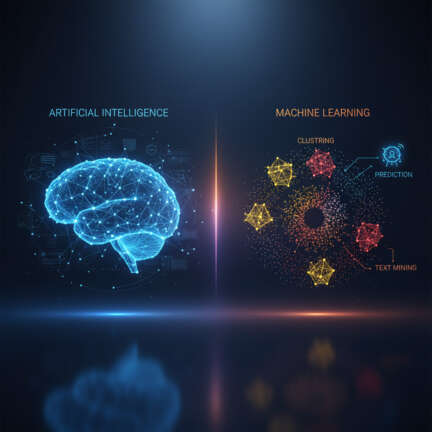

The world of technology is constantly evolving, with new buzzwords and advancements popping up every day. Two terms that have been generating significant interest over the past few years are ‘artificial intelligence’ (AI) and ‘machine learning’ (ML). These concepts represent some of the most cutting-edge technologies in the tech industry today, but they can be confusing if you’re not familiar with them. This article aims to provide a clear understanding of AI and ML, their differences, applications, and importance.
What is Artificial Intelligence?
Artificial intelligence (AI) refers to the simulation of human intelligence processes by computer systems, including learning, reasoning, problem-solving, perception, and natural language processing. At its core, AI involves creating algorithms that can perform tasks that typically require human-like cognitive skills.
A common misconception is that AI replaces human decision-making entirely. In reality, AI enhances human capabilities and automates repetitive or complex processes to make them more efficient. It encompasses a wide range of technologies such as robotics, natural language processing (NLP), expert systems, computer vision, and deep learning, all aimed at making machines smarter and more capable.
Key Applications of AI
AI has numerous applications across various industries:
- Healthcare: From diagnosing diseases to personalized treatment plans, AI is revolutionizing healthcare by providing faster and more accurate diagnoses.
- Finance: Fraud detection, algorithmic trading, risk assessment, and customer service chatbots are just a few examples of how AI is being used in the financial sector.
- Retail: Inventory management, personalized recommendations, and supply chain optimization have all benefited from the use of AI technologies.
What is Machine Learning?
Machine learning (ML) is a subset of artificial intelligence that focuses on enabling machines to learn from data without being explicitly programmed. The goal is to create algorithms and models that can analyze large datasets, identify patterns, make predictions, and improve over time based on new information.
One key aspect of ML is the use of statistical techniques to enable learning. This involves training a model with historical data so it can predict outcomes for future data points. For example, an ML algorithm might be trained using past customer purchase history to recommend products that are likely to interest them in the future.
Types of Machine Learning
Machine learning algorithms fall into several categories:
- Supervised learning: Involves training a model with labeled data where both input and output variables are known. Common applications include classification (e.g., email spam filtering) and regression (predicting numerical values).
- Unsupervised learning: Deals with unlabeled data, focusing on discovering patterns or intrinsic structures within the data.
- Semisupervised learning: Combines both labeled and unlabeled data during training to improve accuracy when dealing with limited labeled datasets.
Differences Between AI & ML
While often used interchangeably, there are distinct differences between artificial intelligence (AI) and machine learning (ML).
The primary distinction lies in their scope and objectives. As mentioned earlier, AI encompasses a broader range of technologies designed to simulate human cognitive functions. It includes everything from rule-based expert systems to complex neural networks capable of deep learning.
Relationship Between AI & ML
Machine learning is one of the core components that power many modern AI applications. In essence, ML provides a way for computers to learn and improve autonomously based on data inputs, which forms an integral part of creating intelligent systems.
- IBM explains how machine learning enables smart decision-making in various industries by automating complex processes and predicting outcomes.
Real-World Examples of AI & ML
The impact of artificial intelligence and machine learning can be seen everywhere, from everyday consumer products to large-scale industrial applications:
Social Media: Platforms like Facebook use AI algorithms to personalize content for users based on their interactions. These systems analyze vast amounts of user data to recommend friends, pages, or posts.
Self-Driving Cars: Autonomous vehicles are a prime example of advanced AI and ML in action. They rely on sophisticated computer vision techniques to navigate roads safely while making real-time decisions based on sensor inputs.
- The Google Cloud article provides insights into how AI and ML technologies are transforming the automotive industry through innovative solutions.
Tips for Implementing AI & ML in Your Business
To effectively integrate artificial intelligence and machine learning into your business, consider these tips:
- Identify areas where automation could improve efficiency or add value to customer experiences.
- Evaluate available tools and platforms that cater specifically to your industry needs.
- Invest in data quality since accurate information is crucial for training ML models effectively.
Taking the Next Steps
Understanding artificial intelligence (AI) and machine learning (ML) opens up numerous opportunities for innovation across various sectors. By leveraging these technologies, businesses can enhance operational efficiency, provide better customer experiences, and gain a competitive edge in today’s fast-paced digital landscape.
To deepen your knowledge further, explore additional resources such as the Wikipedia entry on machine learning or visit Columbia University’s AI engineering site for more detailed explanations of specific concepts and applications.
Tl;dr: Key Takeaways
In summary:
- Artificial intelligence (AI) simulates human cognitive functions using computer systems, while machine learning (ML) focuses on enabling machines to learn from data without explicit programming.
- The relationship between AI and ML is symbiotic; ML powers many modern AI applications by providing a way for computers to improve autonomously through data analysis.
- Implementing these technologies requires identifying areas of potential impact, evaluating suitable tools, and investing in high-quality data.