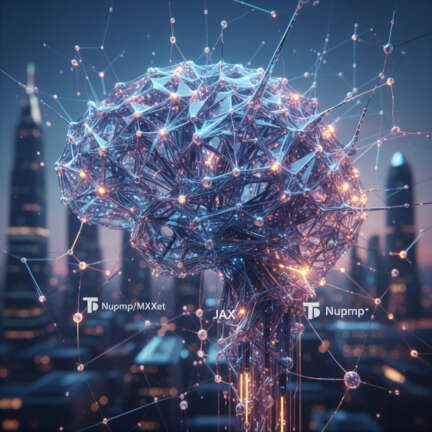

Artificial Intelligence (AI) and Machine Learning (ML) are two of the most transformative technologies of our time. They are revolutionizing industries, from healthcare to finance, and are at the core of many innovative applications we use daily. But what exactly are AI and ML? How do they differ, and how do they work together? This guide aims to demystify these concepts, providing a clear understanding for students, professionals, and businesses alike.
Whether you’re a beginner looking to grasp the basics or a seasoned professional seeking to deepen your knowledge, this article will cover the fundamentals of AI and ML, their key differences, the types of AI algorithms, and the processes involved in AI training, deployment, and inference. By the end, you’ll have a solid foundation to build upon and a clearer picture of how these technologies can be applied in real-world scenarios.
Understanding Artificial Intelligence
Artificial Intelligence refers to the simulation of human intelligence in machines that are programmed to think and learn like humans. These systems are designed to perform tasks that typically require human intelligence, such as visual perception, speech recognition, decision-making, and language translation. AI can be categorized into two main types: narrow AI and general AI.
Narrow AI, also known as weak AI, is designed to perform a narrow task, such as facial recognition or internet searches. It operates under a limited set of constraints and does not possess general intelligence. On the other hand, general AI, or strong AI, has the ability to perform any intellectual task that a human can do. While narrow AI is prevalent today, general AI remains a future aspiration.
Understanding Machine Learning
Machine Learning is a subset of AI that focuses on the development of algorithms that allow computers to learn from data. Instead of being explicitly programmed to perform a task, ML algorithms use statistical methods to identify patterns and make decisions with minimal human intervention. The primary goal of ML is to create systems that can improve their performance over time as they are exposed to more data.
ML can be further divided into three main types: supervised learning, unsupervised learning, and reinforcement learning. In supervised learning, algorithms are trained on labeled data, meaning the input data is paired with the desired output. Unsupervised learning, on the other hand, involves training algorithms on unlabeled data, allowing them to identify hidden patterns or intrinsic structures. Reinforcement learning is a type of ML where an agent learns to make decisions by performing actions in an environment to achieve a goal.
The Key Differences Between AI and ML
While AI and ML are often used interchangeably, they are not the same. AI is a broader concept that encompasses any technique that enables computers to mimic human behavior, while ML is a specific application of AI that involves learning from data. Think of AI as the overarching field and ML as one of the many tools within that field.
For example, AI can include rule-based systems that use predefined rules to make decisions, whereas ML relies on statistical methods to learn from data. Another key difference is that AI aims to create systems that can perform tasks requiring human intelligence, while ML focuses on creating systems that can learn from data and improve over time. For a more detailed comparison, you can refer to resources like cloud.google.com and aws.amazon.com.
Types of AI Algorithms
AI algorithms are the backbone of intelligent systems. They enable machines to perform complex tasks by processing data and making decisions. Some of the most common types of AI algorithms include decision trees, neural networks, support vector machines, and k-means clustering. Each of these algorithms has its strengths and is suited to different types of problems.
Decision trees, for example, are used for classification and regression tasks. They work by splitting the data into subsets based on the value of input features. Neural networks, on the other hand, are inspired by the structure of the human brain and are particularly effective for tasks like image and speech recognition. Support vector machines are used for classification tasks and work by finding the hyperplane that best separates different classes of data. K-means clustering is an unsupervised learning algorithm used for grouping similar data points together.
AI Training, Deployment, and Inference
AI systems go through several stages before they can be used in real-world applications. The first stage is AI training, where algorithms are fed large amounts of data to learn patterns and make predictions. This process involves tuning the algorithms to achieve the best possible performance. Once the algorithms are trained, they are deployed into production environments where they can make real-time decisions.
AI inference is the process of using a trained model to make predictions on new data. This is where the real value of AI lies, as it allows systems to make decisions based on the knowledge they have acquired during training. For more insights into the AI lifecycle, you can explore resources like ibm.com and columbia.edu.
The Future of AI and ML
The future of AI and ML is bright and full of potential. As technology advances, we can expect to see AI systems becoming more sophisticated and capable of performing even more complex tasks. Areas like healthcare, finance, and transportation are already seeing significant impacts from AI, and this trend is likely to continue.
One of the most exciting developments in AI is the rise of deep learning, a subset of ML that uses neural networks with many layers to process data. Deep learning has led to breakthroughs in areas like computer vision and natural language processing. As AI continues to evolve, we can expect to see more innovative applications that will transform the way we live and work.
TL;DR
In summary, AI and ML are powerful technologies that are reshaping the world as we know it. AI encompasses any technique that enables computers to mimic human behavior, while ML is a specific application of AI that involves learning from data. Understanding the differences between AI and ML, as well as the various types of algorithms and processes involved, is crucial for anyone looking to harness the power of these technologies. Whether you’re a student, professional, or business, the insights and knowledge gained from this guide will help you navigate the exciting world of AI and ML.