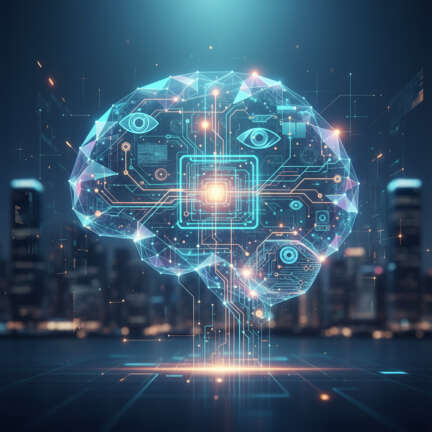

Deep learning has been a game-changer in the field of artificial intelligence (AI), revolutionizing how machines learn and make decisions. As we move through 2026, the advancements in deep learning continue to push the boundaries of what’s possible. This article delves into the intricacies of deep learning, its various types, and its profound impact on AI technology.
For tech enthusiasts, AI professionals, and machine learning engineers, understanding deep learning is crucial. It’s not just about keeping up with the latest trends; it’s about grasping the fundamental shifts that are redefining the tech landscape. Whether you’re a seasoned expert or a curious beginner, this guide will provide valuable insights into the world of deep learning.
Understanding Deep Learning
Deep learning is a subset of machine learning that uses neural networks with many layers to analyze various factors of data. These neural networks are designed to simulate the way the human brain analyzes and processes information. The ‘depth’ in deep learning comes from the number of layers in these networks, which allows for more complex data processing and pattern recognition.
The primary goal of deep learning is to create models that can make accurate predictions or decisions without human intervention. This is achieved through a process called training, where the neural network is fed large amounts of data and adjusts its internal parameters to minimize the difference between its predictions and the actual outcomes. This iterative process is what enables deep learning models to learn and improve over time.
Neural Networks: The Backbone of Deep Learning
Neural networks are the foundation of deep learning. They consist of layers of interconnected nodes, or neurons, that process input data and produce an output. Each layer performs a specific function, such as detecting edges in an image or recognizing speech patterns. The more layers a neural network has, the more complex the data it can process.
There are several types of neural networks used in deep learning, including convolutional neural networks (CNNs) for image recognition, recurrent neural networks (RNNs) for sequential data like speech and text, and transformers for natural language processing. Each type of network is designed to handle specific types of data and tasks, making them essential tools in the deep learning toolkit.
The Types of Deep Learning
Deep learning can be broadly categorized into three types: supervised learning, unsupervised learning, and reinforcement learning. Each type has its unique applications and advantages, depending on the nature of the data and the problem being solved.
Supervised learning involves training a model on a labeled dataset, where the input data is paired with the correct output. This type of learning is useful for tasks like classification and regression, where the goal is to predict a specific outcome based on input data. Unsupervised learning, on the other hand, involves training a model on an unlabeled dataset, where the model must identify patterns and relationships in the data without any prior knowledge of the correct output.
Supervised Learning
Supervised learning is one of the most common types of deep learning. It involves training a model on a dataset that includes both input data and the corresponding correct output. The model uses this information to learn the relationship between the input and output, enabling it to make accurate predictions on new, unseen data. For more detailed information, you can refer to resources like d2l.ai.
Applications of supervised learning include image classification, speech recognition, and predictive analytics. For example, a supervised learning model can be trained to recognize handwritten digits by feeding it images of digits along with their corresponding labels. The model can then be used to classify new, unseen images of digits with high accuracy.
Unsupervised Learning
Unsupervised learning is used when the dataset does not include labeled output data. The model must identify patterns and relationships in the data on its own, without any prior knowledge of the correct output. This type of learning is useful for tasks like clustering, anomaly detection, and dimensionality reduction.
For instance, unsupervised learning can be used to group customers based on their purchasing behavior or to detect fraudulent transactions in a financial dataset. The model can identify patterns and relationships in the data that are not immediately apparent, providing valuable insights for decision-making. More on this can be found on ibm.com.
Reinforcement Learning
Reinforcement learning is a type of deep learning where an agent learns to make decisions by interacting with an environment. The agent receives rewards or penalties based on its actions, and its goal is to maximize the cumulative reward over time. This type of learning is useful for tasks like game playing, robotics, and autonomous vehicles.
For example, a reinforcement learning model can be trained to play a game like chess by receiving rewards for winning and penalties for losing. The model can then be used to play the game against human opponents with high accuracy. For a deeper understanding, check out udlbook.github.io.
The Applications of Deep Learning
Deep learning has a wide range of applications across various industries. Its ability to process and analyze large amounts of data makes it an invaluable tool for solving complex problems and making accurate predictions. Some of the most notable applications of deep learning include image recognition, speech recognition, natural language processing, and predictive analytics.
In the field of healthcare, deep learning is being used to develop diagnostic tools that can detect diseases like cancer with high accuracy. In the automotive industry, deep learning is powering the development of autonomous vehicles that can navigate complex environments and make real-time decisions. The potential applications of deep learning are virtually limitless, and its impact on various industries is only expected to grow in the coming years.
The Future of Deep Learning
As we move through 2026, the future of deep learning looks bright. Advancements in hardware and software are enabling the development of more powerful and efficient deep learning models. The integration of deep learning with other technologies like the Internet of Things (IoT) and edge computing is opening up new possibilities for its application.
One of the most exciting developments in deep learning is the rise of explainable AI (XAI). XAI aims to make deep learning models more transparent and interpretable, enabling humans to understand and trust their decisions. This is particularly important in industries like healthcare and finance, where the stakes are high, and the consequences of incorrect decisions can be severe.
TL;DR
Deep learning is a powerful subset of machine learning that uses neural networks to analyze and process data. It can be categorized into supervised learning, unsupervised learning, and reinforcement learning, each with its unique applications and advantages. The applications of deep learning are vast and varied, with significant impact across industries like healthcare, automotive, and finance. As we move through 2026, the future of deep learning looks promising, with advancements in hardware, software, and explainable AI paving the way for even more innovative applications.