
In the rapidly evolving world of artificial intelligence (AI), deep learning has emerged as a transformative force. It’s enabling breakthroughs in data science, predictive modeling, and even marketing automation. But what exactly is deep learning, and how is it different from traditional machine learning? More importantly, how can data scientists, marketers, and business professionals leverage its power to drive innovation and efficiency?
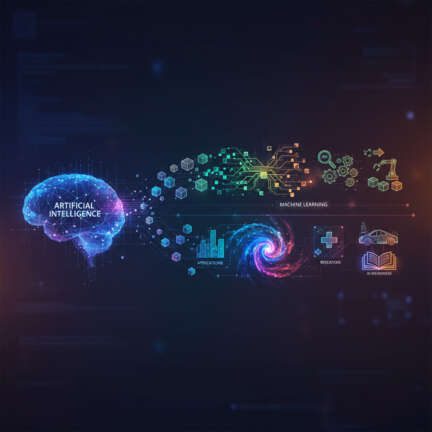
Deep learning is a subset of machine learning, which in turn is a branch of AI. It’s inspired by the structure and function of the human brain, using artificial neural networks to learn from vast amounts of data. The ‘deep’ in deep learning refers to the number of layers in these neural networks. The more layers, the more complex the patterns the network can recognize and learn.
In this article, we’ll delve into the fascinating world of deep learning. We’ll explore its applications in data science, its role in predictive modeling, and its impact on marketing automation and ad targeting. We’ll also provide practical insights and examples to help you understand and implement deep learning in your work.
Understanding Deep Learning
Deep learning is a subset of machine learning that uses neural networks with many layers to learn from data. These networks are called deep neural networks, and they are inspired by the structure and function of the human brain. Each layer in a deep neural network performs a specific task, and the output of one layer becomes the input for the next.
The more layers a network has, the more complex the patterns it can recognize and learn. This is why deep learning is particularly effective for tasks that involve complex patterns, such as image and speech recognition. For more detailed information, you can refer to wikipedia.org.
Deep Learning vs. Traditional Machine Learning
Traditional machine learning algorithms, such as decision trees and support vector machines, are linear models. They can only learn linear relationships between input and output data. Deep learning, on the other hand, is a non-linear model. It can learn complex, non-linear relationships, making it more powerful and flexible.
Another key difference is the amount of data required for training. Traditional machine learning algorithms can work with small datasets, but deep learning algorithms require large amounts of data to achieve optimal performance. This is because deep neural networks have millions of parameters that need to be learned from the data.
Applications of Deep Learning in Data Science
Deep learning is revolutionizing data science, enabling breakthroughs in predictive modeling, natural language processing, and computer vision. Here are some of the most exciting applications:
- Predictive Modeling: Deep learning algorithms can analyze large datasets to identify patterns and make predictions. This is particularly useful in fields like finance, where predictive modeling is used for risk assessment and fraud detection.
- Natural Language Processing: Deep learning is transforming the way we interact with machines. It’s enabling breakthroughs in speech recognition, language translation, and sentiment analysis, making it possible for machines to understand and respond to human language.
- Computer Vision: Deep learning algorithms can analyze and interpret visual data, enabling applications like facial recognition, object detection, and autonomous vehicles.
For more insights into these applications, you can explore ibm.com.
Deep Learning in Marketing Automation
Marketing is another field where deep learning is making a significant impact. It’s enabling breakthroughs in ad targeting, customer segmentation, and personalized marketing, helping businesses to reach the right customers with the right message at the right time.
Ad Targeting
Deep learning algorithms can analyze vast amounts of customer data to identify patterns and predict customer behavior. This enables more accurate and effective ad targeting, improving click-through rates and conversion rates. For instance, deep learning can be used to predict which customers are most likely to respond to a particular ad, allowing marketers to focus their efforts on these customers.
Customer Segmentation
Deep learning can also be used to segment customers based on their behavior, preferences, and demographics. This enables more personalized marketing, improving customer engagement and loyalty. For example, a retail business could use deep learning to segment customers based on their purchase history and browsing behavior, then tailor its marketing messages to each segment.
To understand more about these applications, you can visit geeksforgeeks.org.
Implementing Deep Learning
Implementing deep learning requires a combination of the right tools, techniques, and expertise. Here are some key considerations:
Tools and Frameworks
There are several deep learning frameworks available, each with its own strengths and weaknesses. Some of the most popular ones include TensorFlow, PyTorch, and Keras. These frameworks provide a range of tools and libraries for building, training, and deploying deep learning models.
Data Preparation
Deep learning algorithms require large amounts of high-quality data for training. Data preparation is a critical step in the deep learning pipeline, involving data cleaning, data augmentation, and data normalization. The quality of the data directly impacts the performance of the deep learning model, so it’s important to invest time and effort in this step.
Model Training and Evaluation
Training a deep learning model involves feeding the data into the model and adjusting the model’s parameters to minimize the error between the predicted and actual outputs. This process can be computationally intensive and time-consuming, requiring powerful hardware and optimization techniques. Model evaluation involves testing the model’s performance on a separate validation set and fine-tuning the model as needed.
For a comprehensive guide to implementing deep learning, you can refer to d2l.ai.
Challenges and Limitations
While deep learning offers many benefits, it also presents several challenges and limitations. One of the main challenges is the need for large amounts of data. Deep learning algorithms require vast amounts of data for training, which can be difficult and expensive to obtain. Another challenge is the computational complexity of deep learning, which requires powerful hardware and optimization techniques.
Deep learning also has limitations in terms of interpretability. Deep neural networks are often referred to as ‘black boxes’ because their internal workings are difficult to understand. This can make it challenging to explain and justify the model’s predictions, which is a critical requirement in many applications.
TL;DR
Deep learning is a powerful and versatile tool that’s transforming fields like data science and marketing. It enables breakthroughs in predictive modeling, natural language processing, computer vision, ad targeting, and customer segmentation. However, implementing deep learning requires the right tools, techniques, and expertise, as well as an understanding of its challenges and limitations.
As a data scientist, marketer, or business professional, understanding deep learning can give you a competitive edge. It can help you leverage the power of AI to drive innovation, efficiency, and growth in your organization. So, start exploring the fascinating world of deep learning today, and discover how it can transform your work.