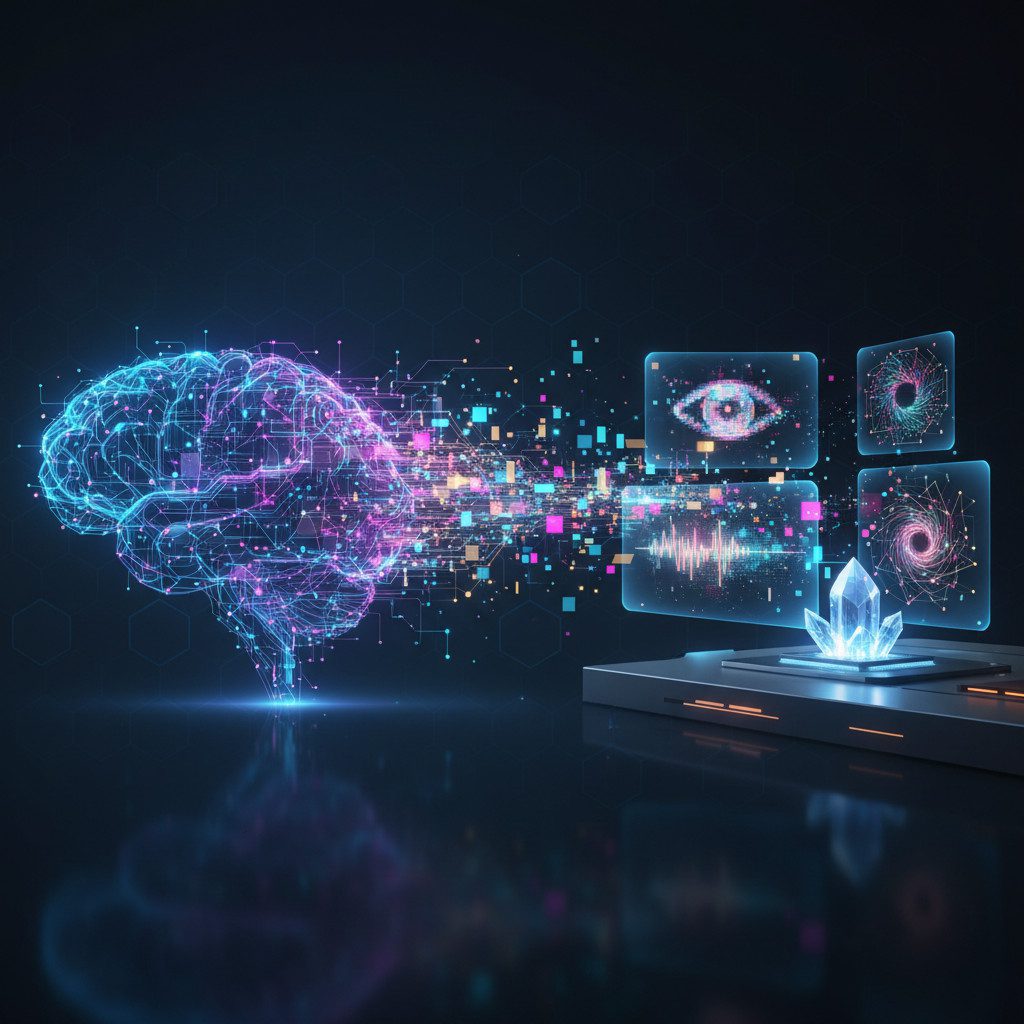

Deep learning is a rapidly evolving field within artificial intelligence (AI) that has revolutionized the way we approach complex problems like image recognition, speech synthesis, and natural language understanding. This technology leverages layers of artificial neural networks to model high-level abstractions in data, enabling machines to learn from vast amounts of information with minimal human intervention. The impact of deep learning can be seen across various domains such as healthcare, finance, automotive, and more. In this article, we will delve into the intricacies of deep learning, its applications, and how it is shaping the future of AI technology.
Understanding Deep Learning
The concept of deep learning originated from neural networks, which are inspired by the structure and function of biological neurons in the human brain. Traditional machine learning models often require extensive feature engineering to extract meaningful information from raw data. However, deep learning automates this process through backpropagation algorithms that allow neural networks to learn hierarchical representations directly from data.
At its core, a deep learning model consists of multiple layers of interconnected nodes or neurons. Each layer processes different features of the input data and passes them on to subsequent layers until reaching the output layer where predictions are made. This multi-layer architecture enables the network to capture complex patterns that would be difficult for conventional algorithms to detect.
Neural Network Architectures
Several types of neural networks have emerged over time, each tailored towards specific tasks within deep learning:
- Convolutional Neural Networks (CNNs): Designed primarily for image and video data analysis. CNNs employ convolutional layers that detect local patterns in images through filters applied across different regions.
- Recurrent Neural Networks (RNNs): Suitable for sequential data such as time series, speech signals, or text documents. RNNs maintain an internal state to remember previous inputs and use this information when processing new ones.
- Generative Adversarial Networks (GANs): Consist of two networks – a generator that creates fake samples and a discriminator that tries to distinguish between real and generated data. GANs are widely used for image synthesis, video generation, and enhancing datasets.
CNNs excel at detecting spatial features in images due to their ability to capture local dependencies via convolutional filters. They achieve this by applying multiple kernels across an input image matrix to extract distinctive patterns such as edges or textures before passing them through pooling layers that downsample the feature maps.
Applications of Deep Learning
The versatility of deep learning makes it applicable in numerous fields:
- Image Recognition and Classification: From identifying objects within photographs to diagnosing diseases based on medical scans, CNNs have significantly improved accuracy rates compared to traditional methods.
- Natural Language Processing (NLP): Tasks like sentiment analysis, machine translation, question answering, and text summarization benefit greatly from deep learning models trained on large textual datasets.
- Speech Recognition and Synthesis: Deep neural networks can transcribe spoken words into text accurately while also generating realistic voices for voice assistants or virtual agents.
In healthcare, deep learning has shown promising results in areas like cancer detection through tumor segmentation using CNNs trained on histopathological images. It aids clinicians by providing second opinions and improving patient outcomes.
Challenges and Limitations
Despite its successes, there are several challenges associated with deploying deep learning systems:
- Data Requirement: Training effective models typically demands large quantities of labeled data which might not always be available.
- Interpretability Issues: Black-box nature of neural networks makes it hard to understand decision-making processes inside them. This poses ethical concerns especially in critical domains like medicine or finance.
To mitigate these issues, researchers are exploring techniques such as attention mechanisms that highlight important parts of input sequences during processing or regularization methods that prevent overfitting on training sets.
Future Directions
The future of deep learning looks promising with ongoing advancements in areas like transfer learning, unsupervised pre-training, and reinforcement learning. Transfer learning allows knowledge gained from one task to be applied to another related problem thereby reducing the need for extensive data collection.
Unsupervised methods aim at discovering useful features without relying on explicit labels making them valuable when labeled samples are scarce or expensive to obtain. Reinforcement learning focuses on optimizing policies through trial-and-error interactions with environments which could lead to breakthroughs in robotics and gaming industries.
Educational Resources
For those interested in delving deeper into the world of deep learning, several resources are available:
- D2L AI: An interactive textbook covering fundamental concepts and hands-on projects.
- Coursera Specialization: A series of courses taught by Andrew Ng focusing on practical applications.
These platforms provide comprehensive tutorials, exercises, and real-world case studies helping beginners and experts alike stay updated with latest trends in deep learning research.
Tl;dr
In summary, deep learning represents a major milestone in AI development enabling machines to tackle complex tasks autonomously. Its success lies in its ability to extract meaningful insights from unstructured data without requiring extensive manual feature engineering. As we continue pushing boundaries with novel architectures and training techniques, the potential impact of deep learning on society will only grow stronger.