
The world of technology is rapidly evolving, with Artificial Intelligence (AI) and Machine Learning (ML) leading the charge in transforming businesses across industries. These advanced technologies offer unprecedented opportunities to enhance efficiency, improve decision-making processes, and drive innovation. However, integrating AI and ML into your company requires a solid understanding of these concepts and their practical applications.
In this comprehensive guide, we will explore the fundamental differences between AI and ML, delve into key algorithms and neural networks, discuss the design considerations for building effective AI systems, and provide insights on how to successfully integrate these technologies within your organization. Whether you’re a business owner looking to stay ahead of the curve or an entrepreneur ready to leverage cutting-edge solutions, this article is designed to equip you with the knowledge needed to navigate the complex landscape of AI and ML.
Understanding Artificial Intelligence (AI) & Machine Learning (ML)
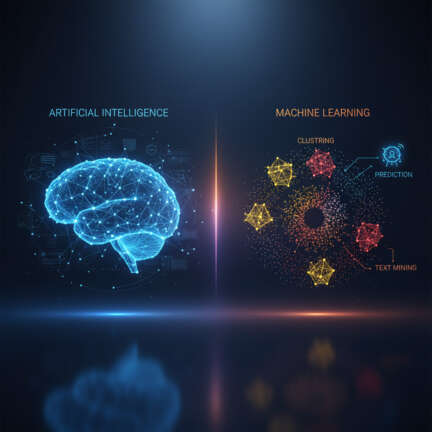
To fully grasp how AI and ML can benefit your business, it’s essential to understand their definitions and distinctions. Google Cloud defines Artificial Intelligence as the broader concept of machines capable of intelligent behavior that mimics human cognition, while Machine Learning is a subset focused on enabling systems to learn from data without being explicitly programmed. In other words, AI encompasses all types of intelligent behaviors in software and hardware, whereas ML specifically deals with algorithms and statistical models used by computer systems to perform tasks traditionally requiring human intelligence.
While both terms are often used interchangeably due to their overlap, it’s crucial to recognize that they represent distinct yet interconnected fields. AI aims to create machines that exhibit human-like cognitive abilities such as reasoning, learning, problem-solving, and perception. On the other hand, ML focuses on developing algorithms that allow computers to learn patterns from large datasets and make predictions or decisions based on those insights.
For instance, an AI-powered chatbot might use natural language processing (NLP) techniques to understand user queries, while a recommendation engine built with ML would analyze customer behavior data to suggest personalized product offerings. Both examples highlight the synergy between AI and ML in delivering intelligent solutions that drive business value.
Key Machine Learning Algorithms & Neural Networks
Moving beyond basic definitions, let’s dive into some fundamental machine learning algorithms and neural networks that form the backbone of many AI applications today. Understanding these concepts will help you appreciate how ML models can be tailored to address specific business challenges.
One popular algorithm is linear regression, which predicts continuous numeric values based on historical data trends. For example, a retail company could use linear regression to forecast future sales figures by analyzing past transaction records. Another widely used method is decision trees, which create hierarchical decision rules from input features for classification or regression purposes.
In addition to these traditional algorithms, neural networks have gained significant traction in recent years due to their ability to model complex nonlinear relationships between inputs and outputs. A neural network consists of interconnected nodes (or neurons) organized into layers that simulate the structure of biological brains. These deep learning architectures enable powerful features such as image recognition, speech synthesis, and natural language understanding.
Consider a scenario where you want to develop an AI system capable of detecting fraudulent transactions in real-time. You might employ convolutional neural networks (CNNs) trained on vast datasets containing labeled examples of legitimate vs. suspicious activities. By leveraging deep learning techniques like CNNs, your model can identify subtle patterns indicative of fraud attempts and alert security teams promptly.
Designing Effective AI Systems
With a solid foundation in place regarding the principles behind AI and ML, we now turn our attention towards designing robust systems that meet business objectives while ensuring ethical considerations are addressed. This involves selecting appropriate algorithms, structuring data pipelines efficiently, implementing monitoring frameworks for continuous improvement, and maintaining transparency throughout development cycles.
A key aspect of successful AI design is choosing the right type of algorithm based on your use case requirements. For instance, if you’re dealing with structured tabular data for predictive analytics tasks like customer churn prediction or credit scoring models, traditional statistical methods may suffice. However, when confronted with unstructured multimedia content such as audio files or video clips, deep learning approaches offer superior performance compared to conventional techniques.
Furthermore, it’s imperative not only to focus on technical aspects but also prioritize ethical guidelines during system design phases. Questions about privacy preservation, bias mitigation, explainability of decisions made by black-box models, and overall fairness should be carefully deliberated upon before deployment stages commence. Addressing these concerns upfront helps build trust among stakeholders while fostering long-term sustainability.
Algorithm Selection Criteria
Selecting the most suitable algorithm hinges on several factors including dataset characteristics, desired outcome metrics, available computational resources, and domain-specific constraints. Here are some guiding principles:
- Data Preprocessing: Cleanse raw data by handling missing values, outliers, imbalances through resampling techniques.
- Feature Engineering: Transform existing attributes into new ones that better capture underlying patterns or relationships within dataset.
- Model Evaluation Metrics: Define key performance indicators (KPIs) such as accuracy, precision-recall tradeoff, ROC-AUC score tailored to specific business needs.
By adhering to these best practices during the design phase, you pave way for deploying high-quality AI solutions that deliver tangible benefits while minimizing potential risks associated with misuse or misinterpretation of results generated by ML models.