
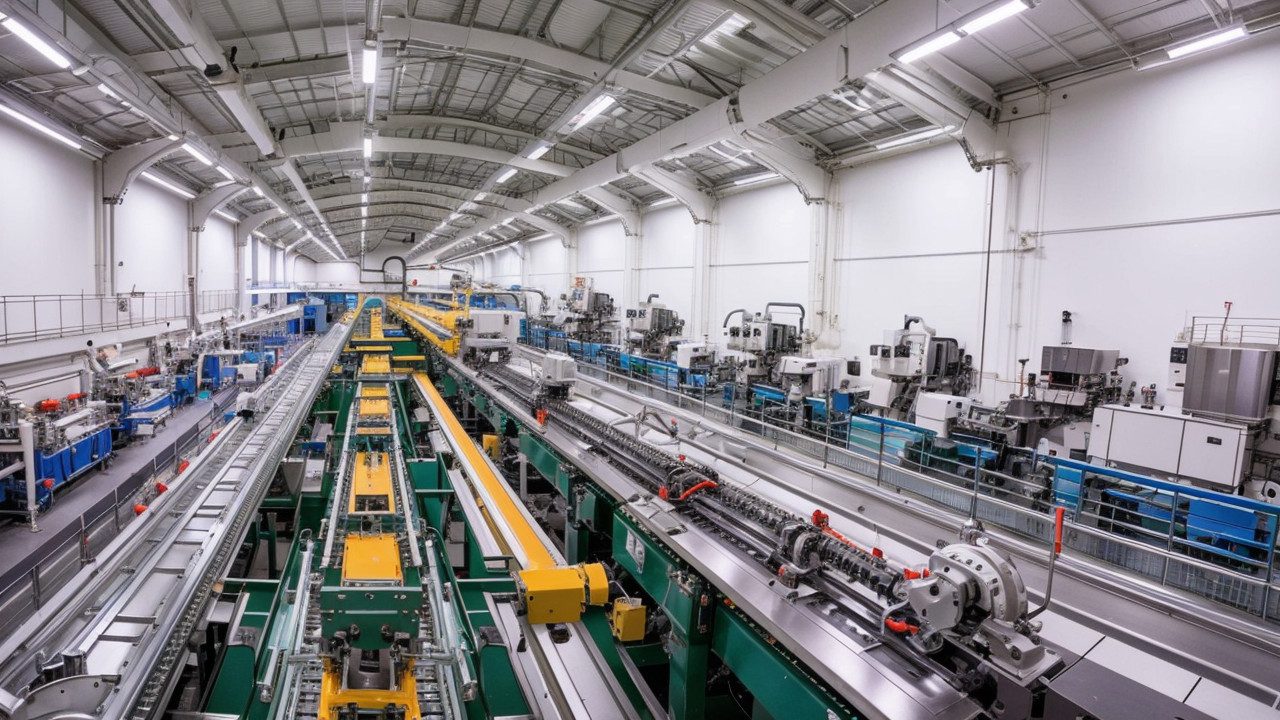

In the modern industrial landscape, the word “efficiency” has taken on a much deeper meaning. It is no longer just about moving faster or producing more; it is about precision, predictability, and the ability to adapt to a volatile global market. For engineers and manufacturing professionals, this shift is being driven by one primary force: automation technology. We are moving away from simple, repetitive mechanical loops toward highly complex, self-correcting ecosystems that can sense, think, and react.
The integration of automation into the production lifecycle is not a sudden event but an ongoing evolution. It represents a fundamental change in how we approach everything from raw material processing to final assembly. As we look at the current state of technology, it is clear that the goal is no longer just to replace manual labor, but to augment human intelligence with machine precision, creating a synergy that was previously impossible.
Whether you are managing a single production line or overseeing a global supply chain, understanding the nuances of automation applications is critical. The following exploration dives into the core pillars of this technological revolution, the challenges of implementation, and what the future holds for those at the forefront of industrial innovation.
The Evolution of Automation Technology
To understand where we are going, we must first look at how far we have come. Historically, automation was synonymous with fixed-sequence machinery—machines designed to do one specific task, over and over, without any ability to deviate from their programming. While this provided incredible speed for high-volume production, it lacked the flexibility required by today’s customized, small-batch manufacturing needs.
Today, the definition of automation has expanded significantly. As noted by lenovo.com, automation involves using various control systems and technologies to reduce the need for human intervention in complex processes. This modern iteration is much more fluid, allowing for a level of adaptability that can respond to real-time changes in demand or material quality.
From Fixed Loops to Intelligent Control Systems
The most significant leap in recent years has been the transition from simple mechanical automation to intelligent control systems. In the old model, if a part was slightly out of tolerance, the machine would continue to process it, leading to waste and downtime. Modern systems, however, are equipped with sensors that provide constant feedback loops.
These intelligent systems can detect anomalies in real-time and make micro-adjustments to the machinery’s parameters. This capability is what separates a standard automated line from a truly smart manufacturing environment. It allows for higher yields and significantly reduces the cost of scrap and rework, making the entire production ecosystem much more resilient.
The Core Pillars: Robotics, AI, and Simulation
The true power of industrial automation lies in the convergence of several distinct but interconnected technologies. We are seeing a “perfect storm” where hardware capabilities (robotics) are meeting unprecedented software intelligence (AI), all supported by advanced mathematical modeling (simulation). When these pillars work together, they create an environment capable of autonomous decision-making.
According to industry leaders at automation.com, the integration of these technologies is what enables the next generation of manufacturing. It is not enough to have a robot; you must have a robot that can perceive its environment and understand the context of its actions.
Robotics and AI in Modern Manufacturing
The marriage of robotics and AI is perhaps the most visible aspect of this revolution. Traditional industrial robots were caged, performing repetitive tasks in isolation. Today, we are seeing the rise of collaborative robots, or “cobots,” which use advanced vision systems and AI-driven algorithms to work alongside humans safely.
AI provides the “brain” for the robotic “body.” Through machine learning, these robots can be trained to recognize different objects, adjust their grip strength based on material fragility, and even predict when a component is about to fail. This level of autonomy is essential for managing the complexity of modern automated manufacturing, where product variety is high and error margins are incredibly low.
Computer-Aided Engineering (CAE) and Process Simulation
Beyond the physical hardware, software plays an equally vital role through computer-aided engineering and process simulation. Before a single machine is even purchased or a production line is laid out, engineers can now build a “digital twin” of the entire factory floor.
Process simulation allows teams to run thousands of “what-if” scenarios in a virtual environment. You can simulate a sudden shortage of raw materials, a power surge, or a breakdown in a critical component to see how the system responds. This proactive approach to engineering minimizes the risks associated with physical deployment and ensures that the automation technology is optimized for maximum throughput before it ever touches the real world.
High-Impact Automation Applications
The reach of automation extends far beyond the automotive assembly line. While manufacturing was the early adopter, we are now seeing profound impacts in sectors ranging from logistics to heavy infrastructure. The common thread across all these applications is the pursuit of extreme precision and the elimination of human error in high-risk or high-precision environments.
As discussed on spiceworks.com, automation is essentially about creating a system that can execute tasks with minimal manual oversight, which is increasingly being applied to complex logistics and data management.
The Rise of the Smart Factory
The “Smart Factory” or Industry 4.0 represents the pinnacle of automated manufacturing. In this setting, every machine, sensor, and even the raw materials themselves are connected via the Industrial Internet of Things (IIoT). This connectivity creates a transparent supply chain where data flows seamlessly from the warehouse to the factory floor and out to the end customer.
In a smart factory, predictive maintenance becomes the standard. Instead of repairing a machine after it breaks, sensors monitor vibrations, temperature, and acoustic signatures to predict a failure weeks in advance. This transforms maintenance from a reactive, expensive headache into a planned, strategic activity that preserves uptime and extends the lifespan of expensive capital equipment.
Breaking Ground with Construction Automation
One of the most surprising frontiers for automation is the construction industry. As highlighted by research found on sciencedirect.com, automation in construction is revolutionizing how we approach large-scale infrastructure projects.
From autonomous bulldozers that can grade land with millimeter precision to 3D printing technologies that can “print” concrete structures, automation is reducing the dangers of high-risk construction sites. These applications not only improve safety by removing humans from dangerous zones but also significantly accelerate project timelines and reduce material waste through much more precise application methods.
Navigating Implementation Challenges
While the benefits of automation are undeniable, the path to implementation is rarely smooth. For engineers and tech professionals, the challenge lies in bridging the gap between legacy systems and new-age intelligence. It is a complex puzzle involving hardware compatibility, data integrity, and organizational change.
The transition requires more than just capital investment; it requires a fundamental rethink of existing workflows. Many companies find themselves stuck in a “hybrid” state, where they are attempting to layer modern AI on top of decades-old mechanical systems, often leading to unforeseen bottlenecks or security vulnerabilities.
Security and System Integration
As factories become more connected, they also become more vulnerable. The integration of IT (Information Technology) and OT (Operational Technology) has opened up new attack vectors for cyber threats. A breach in a smart factory isn’t just about stolen data; it could mean the physical manipulation of machinery, leading to catastrophic real-world consequences.
Furthermore, the sheer complexity of integrating disparate systems—ensuring that a robotic arm from one vendor can communicate perfectly with an ERP system from another—is a massive hurdle. Achieving true interoperability requires standardized protocols and a robust approach to data governance to ensure that the “intelligence” in your control systems is based on accurate, uncompromised information.
The Workforce Transition
Perhaps the most significant challenge is not technical, but human. There is a widespread, often justified, fear that automation will render human workers obsolete. However, the reality is more nuanced. While manual, repetitive roles are indeed declining, there is an exploding demand for workers who can design, maintain, and manage these complex automated systems.
The focus must shift toward upskilling and reskilling. The workforce of the future needs to be proficient in robotics, data analysis, and system troubleshooting. For manufacturers, this means investing in training programs that prepare employees to move from being “operators” to being “system supervisors.” The goal is to create a workforce that leverages automation rather than competes with it.
Future Outlook: Hyper-Automation
Looking ahead, we are entering the era of “hyper-automation.” This refers to the use of advanced technologies like machine learning, RPA (Robotic Process Automation), and low-code platforms to automate as many business and manufacturing processes as possible. The goal is to create a state where even high-level decision-making processes are augmented by automated insights.
We will likely see even deeper integration of edge computing, where the processing happens right at the sensor level, reducing latency to near zero. This will enable even more complex and rapid autonomous responses, making our factories, construction sites, and logistics networks more intelligent, resilient, and efficient than ever before.
TL;DR
Key Takeaways:
- Evolution: Automation has moved from fixed-sequence mechanical loops to highly flexible, intelligent control systems.
- Core Technologies: The synergy of robotics, AI, and computer-aided engineering (CAE) is driving the next industrial revolution.
- Applications: Beyond manufacturing, automation is transforming construction through 3D printing and autonomous machinery.
- Challenges: Implementation requires overcoming significant hurdles in cybersecurity, system interoperability, and workforce upskilling.
- Future Trend: Hyper-automation and edge computing will lead to even more autonomous and responsive industrial ecosystems.




Leave a Comment