
Not too long ago, if a business wanted to launch a new software application or host a massive database, they faced a daunting logistical nightmare. It involved ordering physical servers, finding a climate-controlled room, hiring specialized technicians to manage the hardware, and praying that the electricity didn’t flicker during a storm. This era of heavy capital expenditure and physical dependency is rapidly becoming a relic of the past. Today, the engine of global innovation is powered by the cloud.
Cloud computing has fundamentally rewritten the rules of how technology is consumed and deployed. It has democratized access to high-performance computing, allowing a two-scale startup in a garage to access the same level of computational power as a Fortune 500 conglomerate. Whether you are an IT professional managing complex infrastructures or a business leader deciding on your next big tech investment, understanding the nuances of the cloud is no longer optional—it is a prerequisite for survival in the digital age.
In this deep dive, we will move beyond the buzzwords to explore what cloud computing actually entails, the different service models that define the industry, and the strategic advantages that make it the backbone of modern enterprise. We will also look toward the horizon to see how emerging trends like edge computing are shaping the next generation of cloud technology.
Defining Cloud Computing: More Than Just Remote Storage
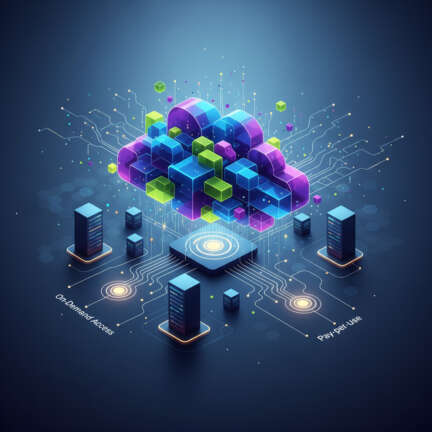
At its simplest level, cloud computing is the on-demand delivery of computing services—including servers, storage, databases, networking, software, and analytics—over the internet. Instead of owning and maintaining physical data centers and servers, you access technology services from providers like Amazon Web Services (AWS), Microsoft Azure, or Google Cloud. This “on-demand” nature is the magic ingredient; it allows you to scale resources up or down instantly based on your current needs.
To understand this more formally, we can look to the standards set by nist.gov, which defines the essential characteristics of cloud computing. These include on-demand self-service, broad network access, resource pooling, rapid elasticity, and measured service. Essentially, the cloud acts like a utility—much like electricity or water. You don’t build a power plant to turn on a lightbulb; you simply plug into the grid and pay for what you use.
The Shift from Local to Remote Infrastructure
The transition from local, on-premises computing to the cloud represents a fundamental shift in the concept of ownership. In the traditional model, computing power was a finite, physical asset that you owned. In the cloud model, computing power is a fluid, scalable service. This shift has removed the “bottleneck of procurement,” where waiting weeks for hardware to arrive could stall a company’s entire development cycle.
This move to remote infrastructure also introduces the concept of virtualization. Cloud providers use advanced software to partition a single physical server into multiple “virtual” machines. This allows for much higher efficiency and much better utilization of hardware, which is a primary driver behind the cost-effectiveness of the cloud. When you use the cloud, you are benefiting from massive economies of scale that no individual company could ever achieve on its own.
Key Characteristics of Cloud Services
What separates a true cloud service from just “someone else’s computer” is the level of automation and intelligence involved. A true cloud service offers rapid elasticity, meaning if your website suddenly gets a million hits due to a viral social media post, the infrastructure expands automatically to handle the load and then shrinks back down once the traffic subsowness. This prevents both site crashes and wasted money.
Furthermore, the measured service aspect is crucial for budgeting. Cloud computing utilizes a “pay-as-you-go” model. You are billed based on consumption—whether that is by the hour, by the gigabyte of storage, or by the number of requests processed. This transparency allows for much more granular control over IT budgets and turns what used to be massive capital expenditures (CapEx) into predictable operational expenditures (OpEx).
The Three Pillars: Understanding IaaS, PaaS, and SaaS
When navigating the cloud landscape, you will frequently encounter the acronyms IaaS, PaaS, and SaaS. These represent the three primary layers of cloud services, each offering a different level of control and management. A helpful way to think about them is by looking at how much of the “stack” the provider manages versus how much you manage. As defined by resources from microsoft.com, the distinction lies in the level of abstraction provided to the user.
Infrastructure as a Service (IaaS)
IaaS is the most fundamental layer. It provides you with the raw building blocks of computing: virtual servers, storage, and networking. When you use IaaS, you are essentially renting the “hardware” in a virtualized form. You are still responsible for managing the operating system, the middleware, the runtime, and your applications, but you no’string longer have to worry about the physical cables, the cooling, or the physical hard drives.
IaaS is ideal for organizations that need maximum control and flexibility. For example, if you have a legacy application that requires a specific, older version of Linux, IaaS allows you to configure that exact environment. It is the foundation upon which more complex cloud architectures are built, providing the essential cloud infrastructure that powers everything else.
Platform as a Service (PaaS)
PaaS moves a step higher up the stack. It provides a framework that allows developers to build, test, and deploy applications without the headache of managing the underlying infrastructure. The provider manages the servers, the operating systems, and the runtime environments, leaving you to focus solely on the application code and the data.
Think of PaaS as a fully equipped workshop. You don’t need to build the workbench or sharpen the saws; you just bring your wood and your tools and start crafting. This significantly accelerates the software development lifecycle (SDLC), as developers can push code to production with much less configuration. It is a massive advantage for companies looking to achieve high levels of on-demand computing and rapid iteration.
Software as a Service (SaaS)
SaaS is the most common form of cloud computing for the average user and many businesses. In this model, the provider delivers a complete, ready-to-use application over the internet. You don’t manage anything related to the underlying infrastructure, the platform, or even the application’s maintenance; you simply use the software through a web browser or an app. Examples include Google Workspace, Salesforce, and Slack.
The beauty of SaaS lies in its simplicity and accessibility. There is no installation required, and updates are handled automatically by the provider. While you have the least amount of control in a SaaS model, you also have the least amount of management overhead. For most standard business functions—like email, CRM, or human resources—SaaS is the gold standard because it allows teams to focus on their core business rather than managing software versions.
The Strategic Benefits of Cloud Computing
The adoption of cloud technology isn’t just a trend; it is a strategic move driven by tangible business advantages. As google.com and other industry leaders have demonstrated, the benefits of moving to the cloud extend far beyond simple convenience. It changes the very DNA of how an organization operates.
Scalability and Agility
In the traditional model, scaling was a slow, manual process. If you needed more capacity, you had to buy more hardware. In the cloud, scalability is nearly instantaneous. This cloud computing technology allows for both vertical scaling (adding more power to an existing server) and horizontal scaling (adding more servers to a pool). This agility allows businesses to respond to market changes in real-time.
Agility also refers to the ability to experiment. Because the cost of failure in the cloud is low—you can simply shut down an instance when you are done testing—companies can engage in much more aggressive R&D. You can spin up a complex environment, test a new feature, and if it fails, delete the infrastructure within minutes, only paying for the few hours of usage.
Cost Efficiency and Resource Management
One of the most significant cloud computing benefits is the transformation of the cost structure. Moving from CapEx to OpEx is a game-changer for cash flow. Instead of a massive, upfront investment in hardware that depreciates over time, companies pay a monthly subscription or a usage-based fee. This allows capital to be redirected toward other critical areas like talent acquisition or product marketing.
Furthermore, the cloud eliminates the “waste” of over-provisioning. In a pre-cloud world, engineers would often buy more capacity than they needed to handle peak loads, meaning that 80% of their hardware sat idle most of the time. With cloud storage and computing, you only pay for the capacity you are actually utilizing, leading to much higher efficiency and better resource management.
Enhanced Security and Disaster Recovery
A common misconception is that the cloud is less secure because your data is “out there.” In reality, major cloud providers invest billions of dollars into security measures that far exceed what most individual companies could ever afford. They employ world-class security experts, utilize advanced encryption, and implement rigorous physical security at their data centers.
Deployment Models: Public, Private, and Hybrid
Not all cloud implementations are the same. Depending on the sensitivity of the data and the specific needs of the organization, companies choose from different deployment models. As noted by ibm.com, the choice of model is a critical part of a company’s broader IT strategy.
Public Cloud: The Shared Ecosystem
The public cloud is the most common model. In this setup, the entire computing infrastructure is owned and operated by a third-party cloud service provider. You share the underlying hardware, storage, and network devices with other organizations (often called “tenants”), though your data remains strictly isolated and secure. It is highly scalable, cost-effective, and requires zero maintenance from your side.
Private Cloud: Dedicated Control
For industries with extreme regulatory requirements—such as banking or healthcare—a private cloud might be more appropriate. A private cloud consists of computing resources used exclusively by one business or organization. It can be physically located on the company’s on-site data center or hosted by a third-party provider. The primary advantage here is total control over the environment and the ability to customize security and compliance settings to an exacting degree.
Hybrid and Multi-Cloud Strategies
Modern enterprises rarely choose just one. The hybrid cloud approach combines public and private clouds, allowing data and applications to move between them. For instance, a company might use a private cloud for sensitive customer records while using the public cloud to run their customer-facing web application. This provides the perfect balance of security and scalability.
Taking it a step further, many organizations are now adopting a multi-cloud strategy. This involves using services from multiple providers (e.g., using AWS for storage and Google Cloud for machine learning). This prevents “vendor lock-in,” ensuring that if one provider has an outage or changes their pricing, the business can remain operational by shifting workloads elsewhere.
The Future Landscape: Edge and AI
As we look toward the future, the cloud is not staying static. We are seeing the rise of edge computing, which brings computation and data storage closer to the sources of data, such as IoT sensors, autonomous vehicles, and mobile devices. By processing data at the “edge” of the network rather than sending everything back to a central data center, we can drastically reduce latency and bandwidth usage.
Furthermore, the integration of Artificial Intelligence (AI) and Machine Learning (ML) into cloud services is creating a new era of intelligent automation. Cloud providers are now offering “AI-as-a-Service,” allowing any developer to plug into incredibly powerful, pre-trained models. This will continue to drive innovation, making the cloud not just a place to store data, but a place to derive profound, actionable intelligence from it.
TL;DR
- What is it? Cloud computing is the on-demand delivery of IT resources over the internet with a pay-as-you-go model.
- The Three Models: IaaS (infrastructure/control), PaaS (platform/development), and SaaS (software/usage).
- Key Benefits: Massive scalability, cost efficiency (CapEx to OpEx), and enhanced disaster recovery.
- Deployment Options: Public (shared/scalable), Private (dedicated/secure), and Hybrid (the best of both worlds).
- The Future: The convergence of edge computing and AI will make the cloud even more distributed and intelligent.