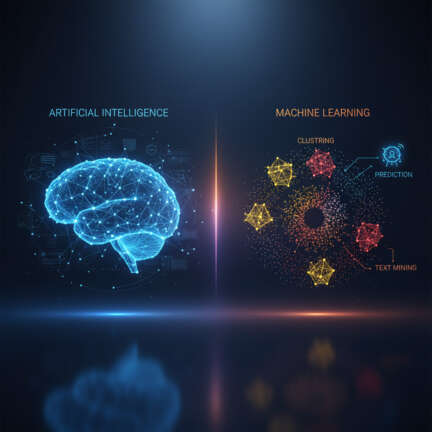

In the current technological era, terms like “Artificial Intelligence” and “Machine Learning” are tossed around with almost reckless abandon. You hear them in boardroom presentations, tech news headlines, and even casual conversations at dinner. For students entering the field or professionals looking to pivot their careers, this linguistic overlap can be incredibly confusing. Is AI the same as Machine Learning? Is Deep Learning just a fancy buzzword for a specific type of algorithm? While they are often used interchangeably in popular media, there are distinct, structural differences that define how these technologies function and how they are applied in the real world.
Understanding these nuances is more than just an academic exercise; it is a fundamental requirement for anyone working in or around modern software development, data science, or robotics. To truly grasp the landscape, one must look past the hype and examine the mathematical and computational hierarchies that separate a broad concept like intelligence from a specific process like pattern recognition. This article aims to peel back those layers, providing a clear, technical, yet accessible roadmap through the complex ecosystem of modern AI.
By the end of this deep dive, you will not only understand the relationship between AI, Machine Learning, and Deep Learning but also the critical distinction between the training and inference phases of a model’s life. Whether you are interested in the mathematical rigor of ML algorithms or the physical implementation of Robotics AI, this guide will provide the foundational clarity you need to navigate the future of automation.
The Hierarchy of Intelligence: Demystifying AI, ML, and Deep Learning
The most common mistake people make is treating Artificial Intelligence, Machine Learning, and Deep Learning as three separate, equal entities. In reality, they are nested layers of a single, larger concept. Think of them like Russian nesting dolls: Artificial Intelligence is the largest doll, Machine Learning is a smaller doll inside it, and Deep Learning is the smallest, most specialized doll at the very center. To understand the whole, you must understand how each layer encapsulates the next.
Artificial Intelligence is the broadest umbrella term. At its core, AI refers to any technique that enables computers to mimic human intelligence. This includes everything from simple “if-then” logic systems used in early chess programs to the most advanced neural networks. As noted by cloud.google.com, the primary goal of AI is to create systems capable of performing tasks that typically require human cognition, such as reasoning, problem-solving, and understanding language.
Machine Learning: The Engine of Learning
Machine Learning (ML) is a specific subset of AI. Unlike traditional AI, which relies on hard-coded rules written by humans, Machine Learning focuses on the idea that we can give machines access to data and let them learn for themselves. Instead of programming a computer to recognize a cat by describing its ears and whiskers, we show it thousands of images of cats and let the algorithms find the commonalities. This shift from “rule-based” to “data-driven” is what revolutionized the industry.
According to insights from ibm.com, Machine Learning is essentially the study of algorithms that improve automatically through experience. It relies heavily on pattern recognition—the ability to identify recurring structures in massive datasets. When you see a recommendation on Netflix or a fraud alert on your credit card, you are seeing Machine Learning in action, processing historical patterns to predict future outcomes.
Deep Learning: Mimicking the Human Brain
Deep Learning is the most specialized layer, a subset of Machine Learning that utilizes multi-layered artificial neural networks. The “deep” in Deep Learning refers to the number of layers through which the data is transformed. These layers are inspired by the biological structure of the human brain, specifically how neurons pass signals to one another. While standard Machine Learning might require a human to manually extract features from data (a process called feature engineering), Deep Learning is capable of “automated feature extraction.”
This capability is what allows Deep Learning to excel in complex tasks like facial recognition and natural language processing. However, it comes at a cost: Deep Learning requires massive amounts of data and significant computational power. As explained by columbia.edu, the distinction lies in the complexity of the architecture. While all Deep Learning is Machine Learning, not all Machine Learning is Deep Learning. The latter is simply a more sophisticated, layer-heavy approach to the latter’s fundamental goal.
The Engine Room: Understanding ML Algorithms and Pattern Recognition
At the heart of every intelligent system is the algorithm. In the context of Machine Learning, an algorithm is not just a set of instructions, but a mathematical framework designed to find patterns within noise. These algorithms are the tools researchers use to turn raw, unstructured data into actionable intelligence. To understand how these work, we need to categorize them by how they learn from their environment.
The complexity of these algorithms varies wildly depending on the task at hand. Some are designed for simple regressions, while others are capable of navigating complex, dynamic environments. The magic happens during the process of pattern recognition, where the algorithm identifies statistical regularities that are invisible to the naked eye. This is the foundation of everything from weather forecasting to autonomous driving.
Supervised, Unsupervised, and Reinforcement Learning
The three primary paradigms of learning are Supervised, Unsupervised, and Reinforcement Learning. Supervised Learning is the most common; it involves training a model on a labeled dataset, where the “answer” is already provided. For example, an algorithm is shown millions of emails labeled as “spam” or “not spam.” The goal is for the model to learn the mapping between the input (the email text) and the output (the label).
Unsupervised Learning, on the other hand, deals with unlabeled data. The algorithm is given a dataset and told to find interesting structures on its own. This is often used for clustering—grouping customers by purchasing behavior or identifying outliers in a manufacturing line. Finally, Reinforcement Learning (RL) is a more dynamic approach. In RL, an “agent” learns by interacting with an environment. It receives rewards for good actions and penalties for bad ones. This is the technology that allows AI to master complex games like Go or to learn how to walk in a simulated physics environment.
The Role of Pattern Recognition
Pattern recognition is the fundamental capability that makes all these learning paradigms possible. It is the process of identifying regularities in data. In a digital image, a pattern might be a specific arrangement of pixels that represents an edge or a curve. In a financial dataset, a pattern might be a specific sequence of trades that precedes a market crash. Without robust pattern recognition, Machine Learning would simply be a collection of random guesses. The strength of an algorithm is often measured by its ability to distinguish true patterns from random noise in high-dimensional data.
The Lifecycle of an AI Model: From Training to Inference
For professionals working in AI deployment, understanding the distinction between “training” and “inference” is critical. These represent two entirely different computational phases, each with its own set of hardware requirements, costs, and challenges. A common mistake is to assume that once a model is “built,” the hard work is over. In reality, the transition from training to inference is where many AI projects succeed or fail in a production environment.
The lifecycle begins with data collection and ends with a model that can make real-time decisions. This loop is continuous; as new data enters the system, models often need to be retrained to maintain accuracy. This cycle is what keeps modern AI systems from becoming obsolete as the world changes around them.
The Heavy Lifting of AI Training
AI Training is the most computationally intensive phase of the lifecycle. During training, the model is exposed to massive datasets, and the underlying weights and biases of the neural network are adjusted through a process called backpropagation. This requires immense processing power, typically provided by high-end GPUs (Graphics Processing Units) or TPUs (Tensor Processing Units). The goal of training is to minimize the “loss function”—the difference between the model’s prediction and the actual truth.
Because of the sheer volume of calculations involved, training can take anywhere from a few hours to several months and can cost millions of dollars in cloud computing fees. This is why training is usually done in centralized data centers. The focus during this stage is on accuracy, convergence, and the ability of the model to generalize to unseen data without “overfitting” (simply memorizing the training set).
The Real-Time World of AI Inference
Once a model has been trained and its parameters are finalized, it is ready for AI Inference. Inference is the process of using the trained model to make predictions on new, unseen data. If training is the “learning” phase, inference is the “application” phase. For example, when you speak to a voice assistant like Siri or Alexa, the model is performing inference to translate your audio waves into text.
Unlike training, inference is often performed on the “edge”—meaning on your smartphone, inside a smart camera, or within a robotic sensor. The priority during inference is speed (latency) and efficiency. While training requires massive power, inference needs to be lightweight and fast. This has led to the rise of “model compression” and “quantization” techniques, which shrink large models so they can run on low-power hardware without losing too much accuracy.
Real-World Applications: From Robotics to Predictive Analytics
The theoretical frameworks of Machine Learning and Deep Learning find their true value when applied to physical and digital environments. We are no longer talking about academic experiments; we are talking about the backbone of modern industry. From the way we move through cities to the way we diagnose diseases, the integration of AI is becoming ubiquitous.
The impact of these technologies is most visible in fields where high-speed data processing and autonomous decision-making are required. These applications rely on the seamless orchestration of training, inference, and pattern recognition to function safely and effectively in unpredictable environments.
Robotics AI and Autonomous Systems
Robotics AI represents one of the most challenging and exciting frontiers of the field. Unlike a chatbot that only processes text, a robot must process a “multimodal” stream of data, including vision, touch, and spatial awareness. This requires highly sophisticated pattern recognition to interpret sensor data and translate it into physical movement. In autonomous vehicles, the system must perform real-tme inference to identify pedestrians, traffic lights, and obstacles within milliseconds.
The integration of Reinforcement Learning has also allowed robots to learn complex manipulation tasks, such as picking up fragile objects or navigating uneven terrain, by practicing in simulated environments before being deployed in the real world. This bridge between digital learning and physical action is what will define the next decade of automation.
Industry-Specific Use Cases
Beyond robotics, the implications for other sectors are profound. In healthcare, Deep Learning models are being used to analyze medical imagery (like MRIs and CT scans) to detect tumors with accuracy that rivals or exceeds human radiologists. In finance, ML algorithms monitor millions of transactions per second to detect patterns indicative of money laundering or fraudulent activity.
Even in agriculture, AI is being used to power “smart” tractors that can identify weeds among crops and apply herbicide with surgical precision, reducing chemical usage and increasing yields. The common thread in all these use cases is the ability to take vast amounts of complex, noisy data and extract meaningful, actionable insights through automated learning.
The Ethical Frontier and Future Challenges
As we push the boundaries of what AI can do, we also encounter significant ethical and technical hurdles. The very power that makes these systems effective—their ability to find patterns in massive datasets—also makes them susceptible to human biases. If a training dataset contains historical prejudices, the resulting model will not only learn those prejudices but may also amplify them.
Furthermore, the “black box” nature of Deep Learning presents a major challenge for high-stakes industries. If an AI denies a loan application or suggests a medical treatment, we need to know *why*. This has given rise to a new field known as XAI (Explainable AI), which focuses on making the decision-making processes of complex models more transparent and interpretable to humans.
TL;DR
Key Takeaways:
- The Hierarchy: AI is the broad field of mimicking intelligence; Machine Learning is a subset focused on learning from data; Deep Learning is a specialized subset using multi-layered neural networks.
- The Mechanics: ML relies on algorithms (Supervised, Unsupervised, Reinforcement) to perform pattern recognition within datasets.
- The Lifecycle: AI Training is the heavy, computationally expensive phase of learning from data; AI Inference is the fast, efficient phase of applying that learning to new data.
- The Impact: From Robotics AI to healthcare, the ability to automate complex decision-making is transforming every major industry.
- The Challenge: Future progress depends on solving issues of algorithmic bias, data privacy, and the need for “Explainable AI” (XAI).