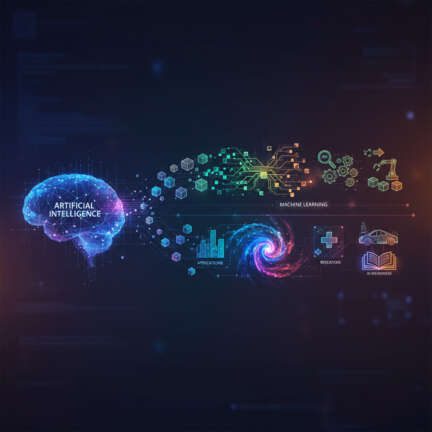

In the rapidly evolving world of artificial intelligence (AI), deep learning has emerged as a game-changer. It’s the technology behind self-driving cars, voice-controlled assistants, and even the recommendations you get on streaming platforms. But what exactly is deep learning, and how can it benefit you? Whether you’re a business owner, developer, or data scientist, understanding deep learning is crucial for staying ahead in today’s tech-driven landscape.
Deep learning is a subset of machine learning (ML), which in turn is a branch of AI. It’s inspired by the structure and function of the human brain, specifically the way neurons process information. Deep learning models, known as neural networks, can automatically discover patterns and features in data, making them incredibly powerful for tasks like image recognition, natural language processing, and predictive analytics.
In this article, we’ll demystify deep learning, explore its applications, and discuss how it can be leveraged to improve predictive accuracy and handle data variability. By the end, you’ll have a solid grasp of this transformative technology and its potential to revolutionize your field.
Understanding Deep Learning
Deep learning is a type of machine learning that uses neural networks with many layers (hence the term ‘deep’) to process data. These networks are designed to mimic the way the human brain works, with each layer performing a specific task, such as identifying edges, shapes, or more complex features.
The key advantage of deep learning is its ability to automatically learn and improve from experience without being explicitly programmed. This makes it particularly useful for handling large amounts of unstructured data, like images, videos, and text, where traditional machine learning methods fall short. According to ncbi.nlm.nih.gov, deep learning models have achieved state-of-the-art performance in various tasks, from speech recognition to drug discovery.
The Role of Neural Networks
Neural networks are the backbone of deep learning. They consist of interconnected nodes or ‘neurons’ organized in layers. The input layer receives data, the hidden layers process it, and the output layer produces the result. Each neuron applies a mathematical function to the input it receives and passes the result to the next layer.
The beauty of neural networks lies in their ability to learn from data. During training, the network adjusts the weights and biases of its connections to minimize the difference between its predictions and the actual values. This process, known as backpropagation, allows the network to improve its accuracy over time. For a more detailed explanation, you can refer to d2l.ai.
Applications of Deep Learning
Deep learning is being used in a wide range of industries, from healthcare to finance, and its applications are continually expanding. Here are some of the most notable examples:
- Image Recognition: Deep learning models excel at identifying and classifying objects in images. This technology is used in facial recognition systems, autonomous vehicles, and medical imaging.
- Natural Language Processing (NLP): NLP involves teaching machines to understand and interpret human language. Deep learning has significantly improved the accuracy of language translation, sentiment analysis, and chatbots.
- Predictive Analytics: By analyzing historical data, deep learning models can predict future trends and behaviors. This is invaluable for businesses looking to optimize operations, personalize marketing, and manage risks.
For instance, deep learning algorithms are used to predict patient outcomes in healthcare, optimize supply chains in logistics, and detect fraud in financial transactions. The versatility of deep learning makes it a powerful tool for solving complex real-world problems.
Handling Data Variability
One of the challenges in machine learning is dealing with data variability. Deep learning models are particularly good at handling this because they can learn hierarchical representations of data. This means they can capture both low-level features (like edges and colors in an image) and high-level features (like shapes and objects) simultaneously.
According to sciencedirect.com, deep learning models can adapt to different types of data distributions, making them robust to variations in the input data. This is crucial for applications where the data is noisy or incomplete, such as in medical diagnosis or environmental monitoring.
Improving Predictive Accuracy
Predictive accuracy is a key metric in evaluating the performance of machine learning models. Deep learning has significantly improved predictive accuracy in various domains, thanks to its ability to learn complex patterns and relationships in data.
For example, in speech recognition, deep learning models have reduced error rates by more than 50% compared to traditional methods. Similarly, in image classification tasks, models like ResNet and Inception have achieved human-level accuracy. This level of performance is possible because deep learning models can learn from large amounts of data and generalize well to unseen examples.
To improve predictive accuracy further, it’s essential to use high-quality data, choose the right model architecture, and fine-tune the hyperparameters. Techniques like data augmentation, transfer learning, and ensemble methods can also enhance the performance of deep learning models. For a comprehensive guide on these techniques, you can visit ibm.com.
Challenges and Future Directions
Despite its many advantages, deep learning also faces several challenges. One of the main issues is the need for large amounts of labeled data for training. This can be time-consuming and expensive to obtain. Additionally, deep learning models are often seen as ‘black boxes,’ making it difficult to interpret their decisions.
Another challenge is the computational resources required to train deep learning models. These models need powerful GPUs and significant memory, which can be a barrier for small businesses and individual researchers. However, advancements in hardware and cloud computing are making deep learning more accessible than ever.
Looking ahead, the future of deep learning is bright. Researchers are exploring new architectures, such as transformers and graph neural networks, to improve performance and efficiency. There’s also growing interest in explainable AI, which aims to make deep learning models more transparent and interpretable.
TL;DR
Deep learning is a powerful subset of machine learning that uses neural networks to automatically learn and improve from data. It’s particularly effective for handling large amounts of unstructured data and has numerous applications, from image recognition to natural language processing. Deep learning models excel at improving predictive accuracy and handling data variability, making them invaluable for businesses and researchers alike.
While deep learning faces challenges, such as the need for large datasets and computational resources, ongoing advancements in technology and research are addressing these issues. As deep learning continues to evolve, it will undoubtedly play a pivotal role in shaping the future of AI and transforming industries across the board.