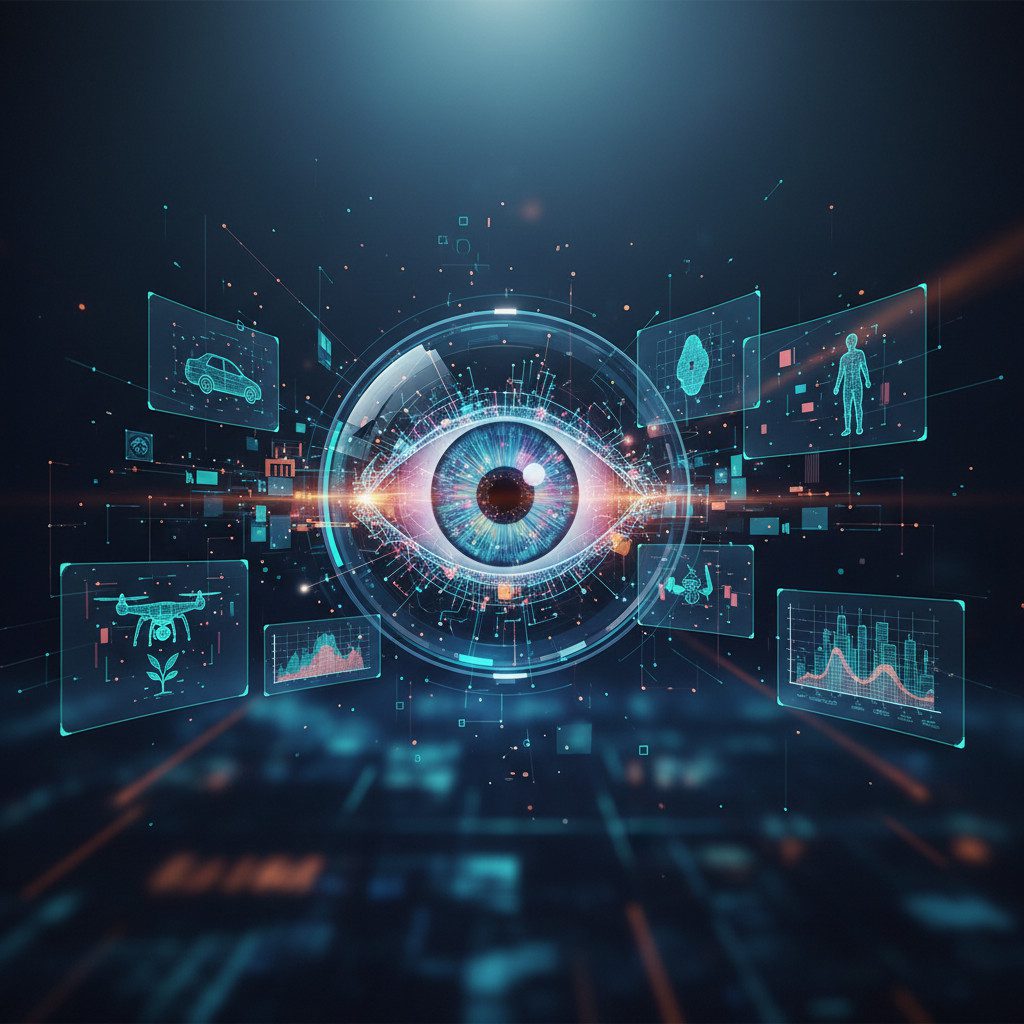

In the rapidly evolving landscape of artificial intelligence, one field stands out for its ability to mimic human perception: computer vision. This technology enables machines to interpret and make decisions based on visual input from the world, much like how humans use their eyes and brain to understand their surroundings. Computer vision is a transformative force, driving innovations across various sectors, from healthcare to autonomous vehicles.
For researchers, developers, and students interested in AI and computer science, understanding computer vision is crucial. It opens up a world of possibilities for creating intelligent systems that can see, understand, and interact with the environment. In this article, we’ll delve into the fundamentals of computer vision, explore its applications, and discuss the key technologies that power it. Whether you’re a seasoned professional or a curious beginner, this guide will provide valuable insights into the fascinating world of computer vision.
What is Computer Vision?
Computer vision is a branch of artificial intelligence that focuses on enabling computers to interpret and make decisions based on visual data. This field combines elements of machine learning, image processing, and deep learning to create systems that can analyze and understand images and videos. The goal of computer vision is to automate tasks that typically require human visual perception, such as object detection, image recognition, and video analysis.
At its core, computer vision involves several key steps. First, the system captures visual data through cameras or other sensors. This data is then processed to extract relevant features, such as edges, shapes, and textures. These features are used to train machine learning models that can recognize patterns and make predictions. The final step involves interpreting the results and making decisions based on the visual input. This process is complex and requires a deep understanding of both computer science and cognitive science.
The History of Computer Vision
The roots of computer vision can be traced back to the early days of artificial intelligence research. In the 1950s and 1960s, pioneers like Marvin Minsky and Seymour Papert began exploring the idea of machines that could see. Their work laid the foundation for the field, but it wasn’t until the advent of digital computers and advanced algorithms that computer vision began to take shape.
Over the years, computer vision has evolved significantly. Early systems relied on simple rule-based approaches, but with the rise of machine learning and deep learning, the field has seen remarkable advancements. Today, computer vision systems can perform tasks with incredible accuracy, thanks to the power of neural networks and large datasets. This evolution has been driven by the need for automation and the desire to create more intelligent machines.
Key Technologies in Computer Vision
Machine Learning
Machine learning is a fundamental technology in computer vision. It involves training algorithms to recognize patterns in data. In the context of computer vision, machine learning models are trained on large datasets of images and videos to learn how to identify objects, scenes, and actions. Supervised learning, where the model is trained on labeled data, is particularly important in computer vision.
One of the most popular machine learning techniques in computer vision is the Support Vector Machine (SVM). SVMs are used for classification tasks, such as identifying objects in images. Another key technique is the Random Forest, which is used for both classification and regression tasks. These techniques have been instrumental in the development of computer vision systems.
Deep Learning
Deep learning is a subset of machine learning that uses neural networks with many layers to model complex patterns in data. Deep learning has revolutionized computer vision, enabling systems to achieve human-like accuracy in tasks such as image recognition and object detection. Convolutional Neural Networks (CNNs) are particularly well-suited for computer vision tasks, as they can effectively capture spatial hierarchies in images.
One of the most famous deep learning models in computer vision is the ResNet (Residual Network). Developed by researchers at Microsoft, ResNet introduced the concept of residual blocks, which allow the network to learn more complex features. Another important model is the YOLO (You Only Look Once) network, which is used for real-time object detection. These models have pushed the boundaries of what is possible in computer vision.
Image Processing
Image processing is a crucial step in computer vision. It involves manipulating images to enhance their quality or extract useful information. Techniques such as filtering, edge detection, and segmentation are commonly used in image processing. These techniques help to prepare the visual data for analysis by machine learning models.
One of the most important image processing techniques is the Sobel operator, which is used for edge detection. Another key technique is the Canny edge detector, which is used to identify edges in images. These techniques are essential for tasks such as object detection and image recognition. Additionally, image processing techniques are used to improve the quality of images, making them more suitable for analysis.
Applications of Computer Vision
Healthcare
Computer vision has numerous applications in healthcare. It is used for tasks such as medical imaging, diagnosis, and treatment planning. For example, computer vision systems can analyze X-rays, MRIs, and CT scans to detect abnormalities and assist doctors in making diagnoses. These systems can also be used to monitor patients and track their progress over time.
One of the most exciting applications of computer vision in healthcare is the detection of diseases such as cancer. Computer vision systems can analyze medical images to identify tumors and other abnormalities with high accuracy. This can lead to earlier detection and more effective treatment. Additionally, computer vision can be used to develop personalized treatment plans based on a patient’s unique characteristics.
Autonomous Vehicles
Autonomous vehicles rely heavily on computer vision to navigate and make decisions. These vehicles use cameras and other sensors to capture visual data from their environment. This data is then processed using computer vision algorithms to identify objects, such as other vehicles, pedestrians, and road signs. The vehicle can then make decisions based on this information, such as when to brake or change lanes.
The development of autonomous vehicles has been driven by the need for safer and more efficient transportation. Computer vision plays a crucial role in achieving this goal. For example, computer vision systems can detect potential hazards on the road and alert the driver or take corrective action. Additionally, computer vision can be used to improve the accuracy of navigation systems, making autonomous vehicles more reliable.
Industrial Automation
Computer vision is widely used in industrial automation to improve efficiency and quality control. It is used for tasks such as inspecting products, identifying defects, and guiding robotic arms. For example, computer vision systems can analyze images of products on an assembly line to detect defects and ensure that only high-quality products are shipped to customers.
One of the most important applications of computer vision in industrial automation is quality control. Computer vision systems can inspect products with high accuracy, reducing the need for human inspectors. This can lead to significant cost savings and improved product quality. Additionally, computer vision can be used to guide robotic arms, enabling them to perform tasks with precision and accuracy.
The Future of Computer Vision
The future of computer vision is bright, with numerous advancements on the horizon. One of the most exciting areas of research is the development of more sophisticated deep learning models. These models will be able to understand and interpret visual data with even greater accuracy, enabling new applications and use cases.
Another important area of research is the integration of computer vision with other technologies, such as the Internet of Things (IoT) and edge computing. This will enable computer vision systems to process data in real-time and make decisions based on the latest information. Additionally, the development of more powerful hardware, such as GPUs and TPUs, will enable computer vision systems to process data more quickly and efficiently.
TL;DR
Computer vision is a transformative technology that enables machines to interpret and make decisions based on visual data. It combines elements of machine learning, image processing, and deep learning to create systems that can analyze and understand images and videos. The history of computer vision is rich, with advancements driven by the need for automation and the desire to create more intelligent machines.
Key technologies in computer vision include machine learning, deep learning, and image processing. These technologies are used to develop systems that can perform tasks such as object detection, image recognition, and video analysis. Applications of computer vision span various industries, including healthcare, autonomous vehicles, and industrial automation.
The future of computer vision is promising, with advancements in deep learning models, integration with other technologies, and the development of more powerful hardware. As the field continues to evolve, computer vision will play an increasingly important role in shaping the world of artificial intelligence. For researchers, developers, and students, understanding computer vision is crucial for creating intelligent systems that can see, understand, and interact with the environment.