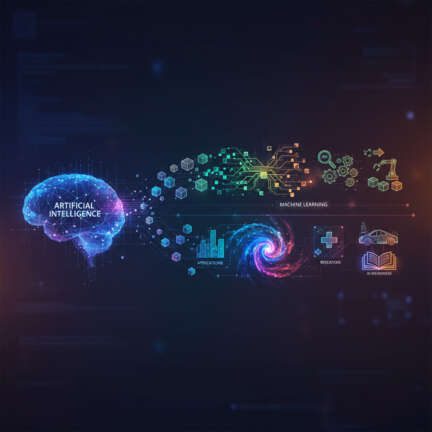

Artificial Intelligence (AI) and Machine Learning (ML) are transforming industries and redefining what’s possible in technology. From autonomous vehicles to personalized recommendations, these technologies are at the forefront of innovation. But what exactly are AI and ML, and how do they work? This guide aims to demystify these concepts, providing a clear and comprehensive overview for data scientists, researchers, and developers.
AI refers to the simulation of human intelligence in machines that are programmed to think and learn. ML, a subset of AI, involves the development of algorithms that allow computers to learn from and make decisions or predictions based on data. Together, they form the backbone of many modern technological advancements. Whether you’re a seasoned professional or just starting out, understanding these technologies is crucial in today’s data-driven world.
Understanding Artificial Intelligence
Artificial Intelligence, or AI, is a broad field that encompasses any technique enabling computers to mimic human intelligence. This includes problem-solving, learning, perception, and language understanding. AI can be categorized into narrow AI, which is designed for a narrow task (like facial recognition or internet searches), and general AI, which has the ability to perform any intellectual task that a human can do.
The applications of AI are vast and varied. In healthcare, AI algorithms can analyze medical images to detect diseases. In finance, AI can predict stock market trends. AI is also revolutionizing customer service through chatbots and virtual assistants. The potential for AI to improve efficiency, accuracy, and innovation across industries is immense.
The Role of AI Algorithms
AI algorithms are the backbone of any AI system. These algorithms are designed to recognize patterns, make decisions, and improve over time. There are several types of AI algorithms, including decision trees, neural networks, and support vector machines. Each type has its strengths and is suited to different kinds of problems.
For example, decision trees are useful for classification and regression tasks, while neural networks are particularly effective for image and speech recognition. The choice of algorithm depends on the specific requirements of the task at hand. Understanding the strengths and limitations of different AI algorithms is crucial for developing effective AI systems.
Exploring Machine Learning
Machine Learning is a subset of AI that focuses on the development of algorithms that allow computers to learn from data. Instead of being explicitly programmed, ML algorithms use statistical methods to identify patterns and make decisions. This ability to learn and adapt makes ML particularly powerful for tasks that involve large amounts of data.
According to mitsloan.mit.edu, ML can be categorized into supervised learning, unsupervised learning, and reinforcement learning. Supervised learning involves training algorithms on labeled data, while unsupervised learning involves finding patterns in unlabeled data. Reinforcement learning involves training algorithms through rewards and punishments.
Applications of Machine Learning
ML has a wide range of applications across various industries. In healthcare, ML algorithms can predict disease outbreaks and personalize treatment plans. In finance, ML can detect fraudulent transactions and assess credit risks. In retail, ML can optimize inventory management and provide personalized recommendations.
The versatility of ML makes it a valuable tool for any industry looking to leverage data for better decision-making. As the amount of data continues to grow, the importance of ML will only increase. Understanding how to develop and implement ML algorithms is a valuable skill for any data scientist or developer.
Deep Learning and Beyond
Deep Learning is a subset of ML that involves the use of neural networks with many layers. These deep neural networks can model complex patterns in large amounts of data, making them particularly effective for tasks like image and speech recognition. Deep Learning has been responsible for many of the recent advancements in AI, including the development of autonomous vehicles and virtual assistants.
According to sas.com, Deep Learning is just one of many advancements in AI. Other areas of research include natural language processing, computer vision, and robotics. Each of these areas has the potential to revolutionize industries and improve our daily lives.
Future of AI and ML
The future of AI and ML is bright. As technology continues to advance, we can expect to see even more innovative applications of these technologies. From personalized medicine to smart cities, the potential for AI and ML to improve our lives is immense.
According to science.nasa.gov, the integration of AI and ML with other emerging technologies, like the Internet of Things (IoT) and blockchain, will open up new possibilities for innovation. Understanding these technologies and their potential applications is crucial for anyone looking to stay ahead in the rapidly evolving field of AI and ML.
Pattern Recognition and Information Retrieval
Pattern recognition and information retrieval are two key applications of AI and ML. Pattern recognition involves the identification of patterns in data, while information retrieval involves the extraction of relevant information from large datasets. These applications are crucial for tasks like image and speech recognition, as well as search engines and recommendation systems.
Inductive logic programming is another area of research that combines ML with logic programming. This approach involves the use of logical rules to guide the learning process, resulting in more interpretable and robust models. Understanding these techniques and their applications is valuable for any data scientist or developer.
TL;DR
In this guide, we’ve explored the world of AI and ML, their applications, and their potential for the future. AI and ML are transforming industries and redefining what’s possible in technology. Understanding these technologies is crucial for anyone looking to stay ahead in the rapidly evolving field of AI and ML.
Key takeaways include the broad applications of AI, the different types of ML algorithms, the advancements in Deep Learning, and the future potential of AI and ML. Whether you’re a seasoned professional or just starting out, understanding these technologies is crucial in today’s data-driven world.