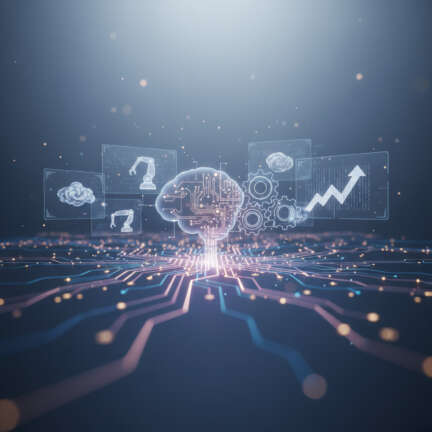

In the rapidly evolving world of artificial intelligence (AI), deep learning has emerged as a game-changer. This powerful subset of machine learning leverages computational models composed of multiple processing layers to learn and make decisions. Whether you’re a professional in the field or a student eager to understand the intricacies of AI, this article will provide a comprehensive overview of deep learning, its applications, and its impact on various industries.
Deep learning is transforming the way we interact with technology, from speech recognition systems like Siri and Alexa to advanced robotics applications. Understanding the fundamentals of deep learning can open up a world of opportunities in AI and machine learning. Let’s dive in and explore the fascinating world of deep learning.
What is Deep Learning?
Deep learning is a subset of machine learning that uses artificial neural networks with multiple layers to process and analyze data. These networks are inspired by the human brain and are designed to recognize patterns and make decisions with minimal human intervention. The term ‘deep’ refers to the number of layers in the network, which allows for the learning of hierarchical representations of data.
Neural networks, the backbone of deep learning, consist of interconnected nodes or ‘neurons’ organized in layers. Each layer performs a specific function, such as detecting edges in an image or recognizing phonemes in speech. The more layers a network has, the more complex the patterns it can learn. This ability to learn at multiple levels of abstraction is what makes deep learning so powerful.
According to wikipedia.org, deep learning algorithms can automatically discover patterns and features in data without the need for human intervention. This is a significant departure from traditional machine learning algorithms, which often require extensive feature engineering.
The Basics of Neural Networks
Neural networks are composed of three main types of layers: input layers, hidden layers, and output layers. The input layer receives the raw data, which is then processed by the hidden layers. Each hidden layer applies a series of transformations to the data, extracting increasingly abstract features. The output layer produces the final result, such as a classification or prediction.
The depth of a neural network, or the number of hidden layers, is what distinguishes deep learning from traditional machine learning. While a shallow network might have just one or two hidden layers, a deep network can have dozens or even hundreds. This increased depth allows the network to learn more complex patterns and representations.
Applications of Deep Learning
Deep learning has a wide range of applications across various industries. One of the most well-known applications is in speech recognition systems like Siri and Alexa. These systems use deep learning algorithms to convert spoken language into text, enabling users to interact with their devices using voice commands.
Another area where deep learning is making a significant impact is in robotics. Deep learning algorithms can be used to train robots to perform complex tasks, such as navigating through a warehouse or assembling products on a manufacturing line. This is made possible by the use of physics-informed neural networks, which combine deep learning with principles from physics to create more accurate and robust models.
According to nature.com, deep learning is also being used in the field of healthcare to improve diagnostic accuracy and treatment outcomes. For example, deep learning algorithms can be used to analyze medical images, such as X-rays and MRIs, to detect signs of disease. This can help doctors make more accurate diagnoses and develop more effective treatment plans.
Deep Learning in Computer Vision
Computer vision is one of the most exciting applications of deep learning. Deep learning algorithms can be used to analyze images and videos, enabling machines to understand and interpret visual data. This has a wide range of applications, from autonomous vehicles to facial recognition systems.
One of the key advantages of deep learning in computer vision is its ability to learn and recognize patterns in images. This is made possible by the use of convolutional neural networks (CNNs), which are specifically designed to process grid-like data, such as images. CNNs can automatically learn to detect features like edges, shapes, and textures, making them highly effective for tasks like object recognition and image classification.
Challenges and Limitations
While deep learning has made significant strides in recent years, it is not without its challenges and limitations. One of the main challenges is the need for large amounts of data. Deep learning algorithms require vast amounts of labeled data to train effectively, which can be a significant barrier for many organizations.
Another challenge is the computational resources required to train deep learning models. Training a deep neural network can require significant computational power, which can be expensive and time-consuming. This has led to the development of specialized hardware, such as graphics processing units (GPUs) and tensor processing units (TPUs), which are designed to accelerate deep learning workloads.
According to geeksforgeeks.org, deep learning models can also be prone to overfitting, where they perform well on the training data but poorly on new, unseen data. This can be mitigated through techniques like regularization and dropout, but it remains a significant challenge in the field of deep learning.
Future Directions
The future of deep learning is bright, with many exciting developments on the horizon. One area of active research is the development of more efficient and effective neural network architectures. This includes the use of techniques like attention mechanisms and transformer models, which have shown promise in improving the performance of deep learning models.
Another area of research is the development of physics-informed neural networks, which combine deep learning with principles from physics to create more accurate and robust models. This has the potential to revolutionize fields like materials science and fluid dynamics, where traditional machine learning algorithms have struggled to make an impact.
Finally, there is a growing interest in the development of explainable AI, which aims to make deep learning models more transparent and interpretable. This is particularly important in fields like healthcare and finance, where the ability to understand and trust the decisions made by AI systems is crucial.
TL;DR
Deep learning is a powerful subset of machine learning that uses artificial neural networks with multiple layers to process and analyze data. It has a wide range of applications, from speech recognition and robotics to computer vision and healthcare. While it faces challenges like the need for large amounts of data and the computational resources required to train models, the future of deep learning is bright with many exciting developments on the horizon.
Understanding the fundamentals of deep learning can open up a world of opportunities in AI and machine learning. Whether you’re a professional in the field or a student eager to learn more, deep learning is a fascinating and rapidly evolving area that is worth exploring.