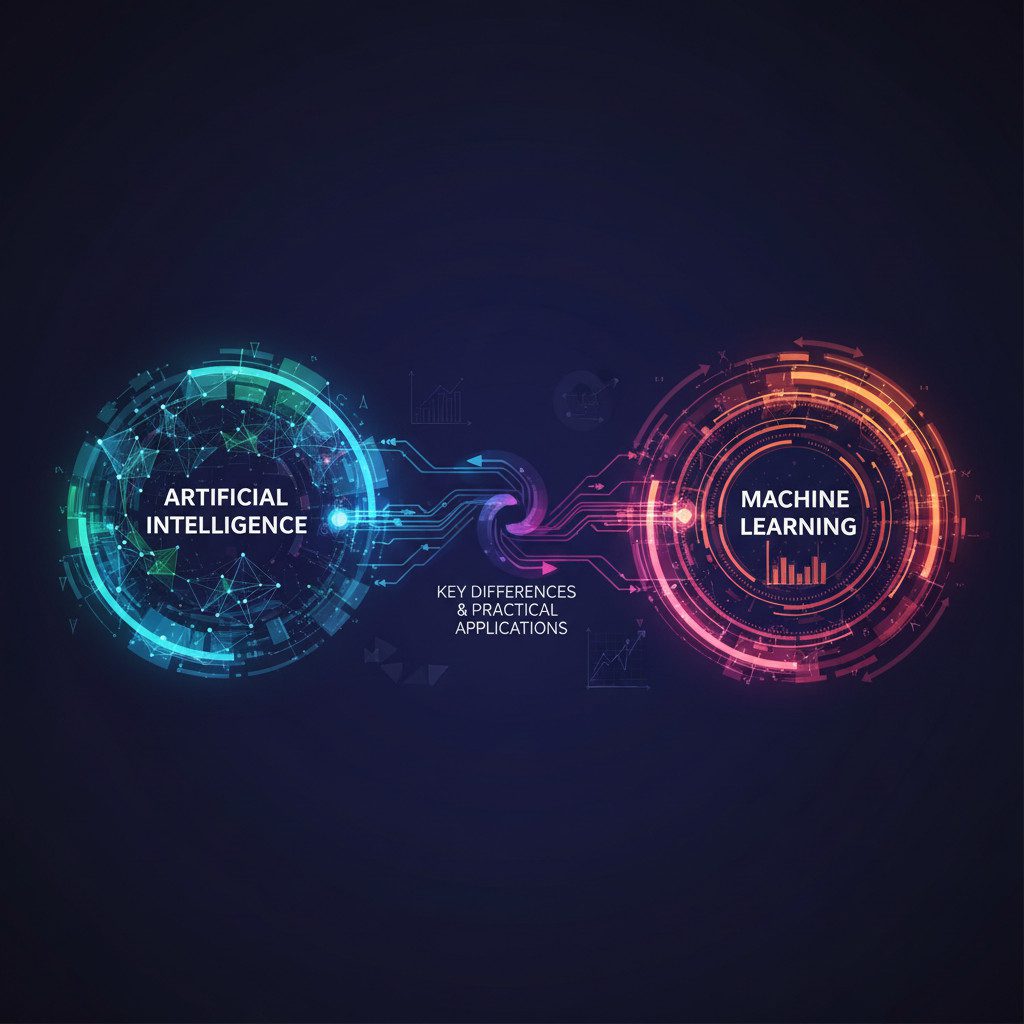

In the rapidly evolving world of technology, two terms that are often used interchangeably but have distinct meanings are Artificial Intelligence (AI) and Machine Learning (ML). While they are related and often work together, understanding their differences is crucial for tech professionals. This article aims to demystify AI and ML, explore their applications, and provide practical insights into their usage.
AI refers to the broader concept of machines being able to carry out tasks in a way that we would consider ‘smart’ or ‘intelligent’. On the other hand, ML is a subset of AI that involves the use of algorithms to parse data, learn from it, and then make a determination or prediction about something in the world. Think of AI as the overarching concept and ML as one of the methods used to achieve AI.
Understanding Artificial Intelligence
Artificial Intelligence is the simulation of human intelligence processes by machines, especially computer systems. These processes include learning (the acquisition of information and rules for using the information), reasoning (using rules to reach approximate or definite conclusions), and self-correction. AI can be classified into two broad types: narrow AI and general AI.
Narrow AI is designed to perform a narrow task (e.g., facial recognition or internet searches) and is often what we see in commercial applications today. General AI, on the other hand, has the ability to perform any intellectual task that a human can do, and is still largely theoretical.
The Role of AI Algorithms
AI algorithms are the backbone of intelligent systems. They enable machines to learn from data, make decisions, and improve their performance over time. These algorithms can be categorized into different types, such as supervised learning, unsupervised learning, and reinforcement learning. Each type has its unique strengths and applications, making them suitable for different scenarios.
For instance, supervised learning algorithms are used when the data is labeled, meaning that the input data is paired with the desired output. This type of learning is commonly used in predictive analytics, where the goal is to predict future events based on historical data. On the other hand, unsupervised learning algorithms are used when the data is not labeled, and the goal is to find hidden patterns or intrinsic structures in the input data. This type of learning is often used in data analysis and pattern recognition.
Exploring Machine Learning
Machine Learning is a subset of AI that focuses on the development of algorithms that can learn from and make predictions on data. These algorithms operate by building a model based on sample data, known as ‘training data’. The model is then used to make predictions or decisions without being explicitly programmed to perform the task.
ML can be further divided into three main categories: supervised learning, unsupervised learning, and reinforcement learning. Each category has its own set of algorithms and applications. For example, supervised learning is often used in predictive analytics, where the goal is to predict future events based on historical data. Unsupervised learning, on the other hand, is used to find hidden patterns or intrinsic structures in the input data, making it ideal for data analysis and pattern recognition.
Deep Learning and Neural Networks
Deep learning is a subset of ML that uses neural networks with many layers to model complex patterns in data. These networks are inspired by the human brain and are designed to recognize patterns and make decisions with minimal human intervention. Deep learning is particularly useful for tasks that involve large amounts of data and complex patterns, such as image recognition and natural language processing.
Neural networks are the building blocks of deep learning. They consist of layers of interconnected nodes, or ‘neurons’, that process input data and pass the results to the next layer. The output of the final layer is the prediction or decision made by the network. Neural networks can be trained using various algorithms, such as backpropagation, which adjusts the weights of the connections between neurons to minimize the error in the network’s predictions.
Applications of AI and ML
AI and ML have a wide range of applications across various industries. In healthcare, for example, AI is used to analyze medical images, predict disease outbreaks, and personalize treatment plans. In finance, ML algorithms are used for fraud detection, risk assessment, and algorithmic trading. In retail, AI is used for personalized recommendations, inventory management, and customer service.
The applications of AI and ML are not limited to these industries. They are also used in transportation, manufacturing, education, and many other fields. As technology continues to evolve, the potential applications of AI and ML will only continue to grow, making them essential tools for tech professionals.
Predictive Analytics and Data Analysis
Predictive analytics is one of the most common applications of AI and ML. It involves using historical data to predict future events, such as customer behavior, equipment failures, or market trends. Predictive analytics is used in various industries, from marketing to healthcare, to make data-driven decisions and improve business outcomes.
Data analysis is another key application of AI and ML. It involves using algorithms to extract insights from large datasets, identify patterns, and make data-driven decisions. Data analysis is used in various fields, from scientific research to business intelligence, to uncover hidden trends and gain a competitive edge.
The Future of AI and ML
The future of AI and ML is bright and full of potential. As technology continues to advance, we can expect to see more sophisticated algorithms, more powerful hardware, and more innovative applications. The integration of AI and ML with other emerging technologies, such as the Internet of Things (IoT) and blockchain, will open up new possibilities and create new opportunities for tech professionals.
However, the future of AI and ML is not without its challenges. Ethical considerations, such as data privacy and algorithmic bias, will need to be addressed to ensure that these technologies are used responsibly and fairly. As tech professionals, it is our responsibility to stay informed about these issues and advocate for ethical and transparent use of AI and ML.
TL;DR
In this article, we explored the differences between Artificial Intelligence and Machine Learning, their applications, and their future potential. Here are the key takeaways:
- AI vs ML: AI is the broader concept of machines being able to carry out tasks in a way that we would consider ‘smart’ or ‘intelligent’, while ML is a subset of AI that involves the use of algorithms to parse data, learn from it, and then make a determination or prediction.
- AI Algorithms: AI algorithms enable machines to learn from data, make decisions, and improve their performance over time. They can be categorized into different types, such as supervised learning, unsupervised learning, and reinforcement learning.
- Machine Learning: ML focuses on the development of algorithms that can learn from and make predictions on data. It can be divided into three main categories: supervised learning, unsupervised learning, and reinforcement learning.
- Deep Learning and Neural Networks: Deep learning is a subset of ML that uses neural networks with many layers to model complex patterns in data. Neural networks are the building blocks of deep learning and consist of layers of interconnected nodes that process input data and pass the results to the next layer.
- Applications: AI and ML have a wide range of applications across various industries, from healthcare to finance to retail. They are used for predictive analytics, data analysis, pattern recognition, and many other tasks.
- Future of AI and ML: The future of AI and ML is bright and full of potential, but it also comes with challenges that need to be addressed, such as ethical considerations and data privacy.
For more information on AI and ML, check out these resources: cloud.google.com, ai.engineering.columbia.edu, and en.wikipedia.org.