
Artificial Intelligence (AI) and Machine Learning (ML) are rapidly evolving fields that have transformed the way we interact with technology in our daily lives. As these technologies continue to advance, it’s crucial for tech-savvy professionals and students to stay informed about their intricacies, applications, and future prospects.
While AI and ML are often used interchangeably, they represent distinct aspects of the same technological landscape. Understanding the nuances between them can provide valuable insights into how these technologies function and impact various industries. This article will delve into the basics of both fields, explore their key differences, and discuss some common misconceptions.
Understanding AI vs. Machine Learning
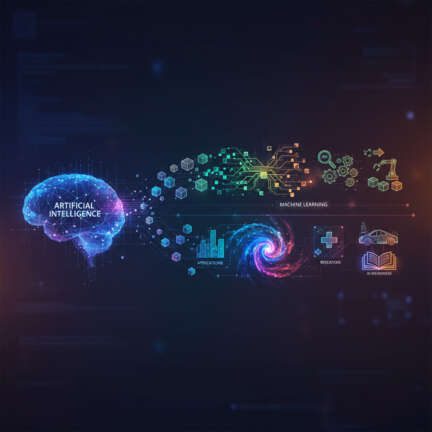
Artificial Intelligence encompasses a broad range of techniques designed to enable machines to perform tasks that typically require human intelligence. These include learning from experience, reasoning, problem-solving, perception, understanding natural language, planning, and more. On the other hand, Machine Learning is a subset of AI that focuses on developing algorithms and statistical models for computer systems to learn from data without being explicitly programmed.
Machine learning algorithms are designed to identify patterns within large datasets and use these insights to make predictions or decisions. This process involves training models with historical data so they can recognize trends, classify information, detect anomalies, and even generate new content such as text or images. The effectiveness of ML algorithms depends largely on the quality and quantity of input data available.
The Role of Data in AI & Machine Learning
Data is the lifeblood of both AI and machine learning systems. Without substantial amounts of high-quality, diverse datasets, these technologies would be unable to function effectively or deliver accurate results. For example, facial recognition technology relies heavily on vast collections of images labeled with corresponding identities. Similarly, natural language processing models require extensive corpora of written text spanning multiple languages and contexts.
One fascinating area where data plays a crucial role is in generating creative outputs through AI. Janelle Shane, known for her work on AI Weirdness, has demonstrated how machine learning algorithms can produce humorous and sometimes nonsensical results when trained on specific datasets. For instance, one of her experiments involved training an algorithm to invent new flavors of chips based on existing recipes. The resulting flavor suggestions ranged from the plausible (like barbecue) to the bizarre (such as pickled dill pickle).
Common Misconceptions About AI & ML
A common misconception is that machine learning algorithms can operate independently without human intervention once they are trained. While it’s true that well-tuned models can make predictions or decisions autonomously, ongoing monitoring and fine-tuning by data scientists remain essential for optimal performance.
Another myth circulating around AI and ML is the idea of achieving full autonomy where machines can think like humans across all domains. Although significant strides have been made in areas such as image recognition and natural language understanding, true general intelligence remains elusive due to complexities inherent in human cognition.
Applications of Machine Learning
The applications of machine learning are vast and varied, spanning industries from healthcare to finance, marketing, and beyond. In healthcare, ML models can assist with disease diagnosis by analyzing medical images or patient records for early detection of conditions such as cancer or Alzheimer’s.
In financial services, predictive analytics powered by ML helps institutions identify potential fraud cases, manage risk portfolios more effectively, and personalize customer experiences through targeted recommendations based on transaction history.
Challenges in Implementing AI & ML
Despite the numerous benefits offered by AI and machine learning technologies, several challenges hinder their widespread adoption. One major obstacle is ensuring ethical use of these systems to avoid biases and discrimination against marginalized groups. For instance, if training data contains historical prejudices or stereotypes about certain demographics, an ML model may inadvertently perpetuate such issues.
Another challenge lies in maintaining transparency when deploying complex AI models that operate like black boxes even for experts. This lack of interpretability makes it difficult to explain decision-making processes to stakeholders unfamiliar with technical details behind the scenes.
The Future of Artificial Intelligence and Machine Learning
The future holds immense potential for advancements in both AI and machine learning as researchers continue pushing boundaries towards developing smarter, more adaptable systems capable of tackling increasingly complex problems. Areas like explainable AI (XAI), which aims to create models whose reasoning can be understood by humans, could greatly enhance trust between users and intelligent machines.
Additionally, we may see greater integration between traditional machine learning approaches and emerging fields such as deep reinforcement learning or neural architecture search (NAS) that leverage advances in computing power and novel architectures like transformers. These innovations hold promise for unlocking new capabilities previously thought impossible.
Tl;dr
AI and machine learning represent powerful tools with transformative potential across diverse sectors. By understanding their fundamental principles, recognizing common pitfalls, and staying abreast of cutting-edge developments, professionals can harness these technologies responsibly while contributing to shaping a smarter future.