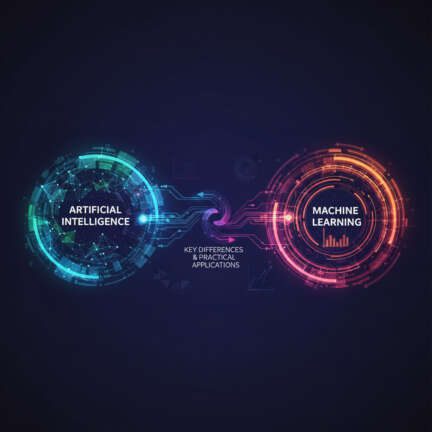

The realm of Artificial Intelligence (AI) and Machine Learning (ML) is rapidly evolving, transforming industries ranging from healthcare to autonomous vehicles. This article delves into the intricacies of AI and ML, covering key topics such as machine learning algorithms, artificial neural networks, deep learning techniques, gradient boosting methods, large language models, and generative AI tools. Whether you’re a developer, data scientist, or IT professional, this guide offers valuable insights to enhance your understanding and proficiency in these cutting-edge technologies.
Understanding Machine Learning Algorithms
Machine learning algorithms are the backbone of any successful AI project. These algorithms enable machines to learn from data without being explicitly programmed, making them indispensable for tasks ranging from predictive analytics to recommendation systems. Common machine learning techniques include supervised learning, unsupervised learning, and reinforcement learning.
Supervised learning involves training models using labeled data, where the algorithm learns a mapping function from inputs to outputs. Unsupervised learning, on the other hand, deals with unlabeled data, aiming to discover hidden patterns or intrinsic structures within the dataset. Reinforcement learning focuses on teaching machines to make decisions in complex environments based on trial and error.
One popular supervised learning algorithm is logistic regression, which is widely used for binary classification tasks like spam detection or fraud prevention. Decision trees are another versatile tool, capable of handling both classification and regression problems by partitioning the feature space into smaller regions. Support vector machines (SVMs) excel at finding hyperplanes that maximize margins between different classes.
Applications of Machine Learning Algorithms
The applications of machine learning algorithms are vast and varied, spanning numerous industries. For instance, in healthcare, predictive models can help identify patients at risk for certain diseases based on their medical history and lifestyle factors. In finance, fraud detection systems use supervised learning to flag suspicious transactions.
Recommender systems, a cornerstone of e-commerce platforms like Amazon or Netflix, rely heavily on collaborative filtering techniques combined with matrix factorization methods. These algorithms analyze user behavior patterns across multiple dimensions—such as product ratings and purchase history—to suggest personalized items that align with individual preferences.
The Power of Artificial Neural Networks
Artificial neural networks (ANNs) mimic the structure and function of biological neurons, enabling computers to process information in ways similar to human brains. ANNs consist of layers of interconnected nodes or neurons, each performing specific computations on input data.
A typical ANN architecture includes an input layer, one or more hidden layers, and an output layer. During training, weights assigned to connections between neurons are adjusted iteratively through backpropagation, minimizing the difference between predicted outputs and actual targets. This process allows ANNs to learn complex patterns within datasets and make accurate predictions.
Deep learning, a subset of machine learning that leverages artificial neural networks with many layers (often called deep neural networks or DNNs), has revolutionized various domains such as computer vision and natural language processing. Convolutional Neural Networks (CNNs) excel at image recognition tasks by extracting hierarchical features from visual inputs, while Recurrent Neural Networks (RNNs) handle sequential data like speech signals or text sequences.
Deep Learning Techniques in Action
In computer vision applications, CNNs have surpassed traditional methods for object detection and scene understanding. By applying convolutional filters to image patches and pooling operations to reduce dimensionality, these networks can efficiently capture spatial hierarchies of features essential for accurate classification.
For natural language processing tasks such as sentiment analysis or machine translation, RNN architectures like Long Short-Term Memory (LSTM) units are particularly effective due to their ability to maintain contextual information over long sequences. Bidirectional LSTMs extend this capability by considering both past and future contexts simultaneously.
Gradient Boosting Methods
Gradient boosting is a powerful ensemble technique that combines multiple weak learners into a strong predictive model through iterative refinement. Each new base learner focuses on correcting the errors made by its predecessors, gradually improving overall performance.
XGBoost and LightGBM are two widely-used implementations of gradient boosting algorithms designed for high efficiency and scalability. They incorporate advanced features such as parallel processing, cache optimization, and regularization techniques to prevent overfitting while maximizing predictive accuracy.
Gradient boosting methods have proven highly effective in various domains, from credit scoring and customer churn prediction to medical diagnosis and genomic sequence analysis. By carefully tuning hyperparameters like learning rates and tree complexities, practitioners can optimize these models for specific problem contexts.
Leveraging Large Language Models (LLMs)
Large language models (LLMs) represent a significant advancement in natural language processing, enabling sophisticated interactions with text-based data. These models are trained on massive corpora of text from diverse sources—books, articles, websites—to capture semantic nuances and contextual relationships.
Popular LLMs include GPT-3, BERT, and RoBERTa, each featuring unique architectures tailored for specific tasks such as question answering or language generation. These models often employ transformer-based encoders that rely on self-attention mechanisms to weigh the importance of different words within a sentence.
LLMs have numerous real-world applications, from chatbots and virtual assistants to content creation tools and automated summarization systems. They can generate human-like text responses, provide insightful answers based on vast knowledge bases, or even create coherent narratives given minimal prompts.
Autonomous Vehicles & AI
The integration of artificial intelligence in autonomous vehicles promises safer roads and more efficient transportation systems. Advanced sensor technologies combined with sophisticated machine learning algorithms enable self-driving cars to perceive their environment accurately, make intelligent decisions, and navigate complex traffic scenarios seamlessly.
Vision-based sensors like LiDAR (Light Detection And Ranging) provide detailed 3D maps of the surroundings, while radar detects moving objects over longer ranges. Cameras capture visual data for object recognition tasks using convolutional neural networks. Fusing information from multiple sources allows autonomous vehicles to build comprehensive situational awareness.
Decision-making frameworks in autonomous driving often incorporate reinforcement learning paradigms where vehicles learn optimal control policies through trial-and-error interactions with the environment. Deep Q-Networks (DQNs) and Proximal Policy Optimization (PPO) algorithms are commonly used for this purpose due to their ability to handle high-dimensional state spaces.
Generative AI Tools
Generative artificial intelligence tools have gained traction across various creative domains, offering novel ways to produce content automatically. Generative models such as Variational Autoencoders (VAEs) and Generative Adversarial Networks (GANs) generate new samples that resemble existing data distributions.
Variational autoencoders encode input vectors into latent representations through an encoder network before reconstructing them via a decoder. This process can be used to infer underlying structure within datasets or synthesize plausible variations. GANs consist of two competing networks—a generator producing synthetic examples and a discriminator distinguishing real from fake samples—which collectively improve model performance over time.
Applications range from image synthesis and music composition to text generation and video editing, opening up exciting possibilities for artists and designers alike. These tools empower creators to experiment with novel ideas effortlessly while pushing boundaries of imagination.
Tl;dr
This article explored the fundamentals of AI and machine learning, covering essential concepts like machine learning algorithms, artificial neural networks, deep learning techniques, gradient boosting methods, large language models, autonomous vehicles technology, and generative AI tools. It provided insights into how these technologies are transforming industries worldwide and highlighted their practical applications across diverse sectors.
Related reading
- Streamline Workflows with Automation Tools and AI — Related article
- Unlocking Fintech Innovations: Digital Money Evolution — Related article
- Optimizing Deep Learning Performance with GPUs — Related article
- Mastering Topic Modeling for Predictive NLP — Related article
- Stay Safe from Tax Scams with IRS Email Alerts and Compliance — Related article