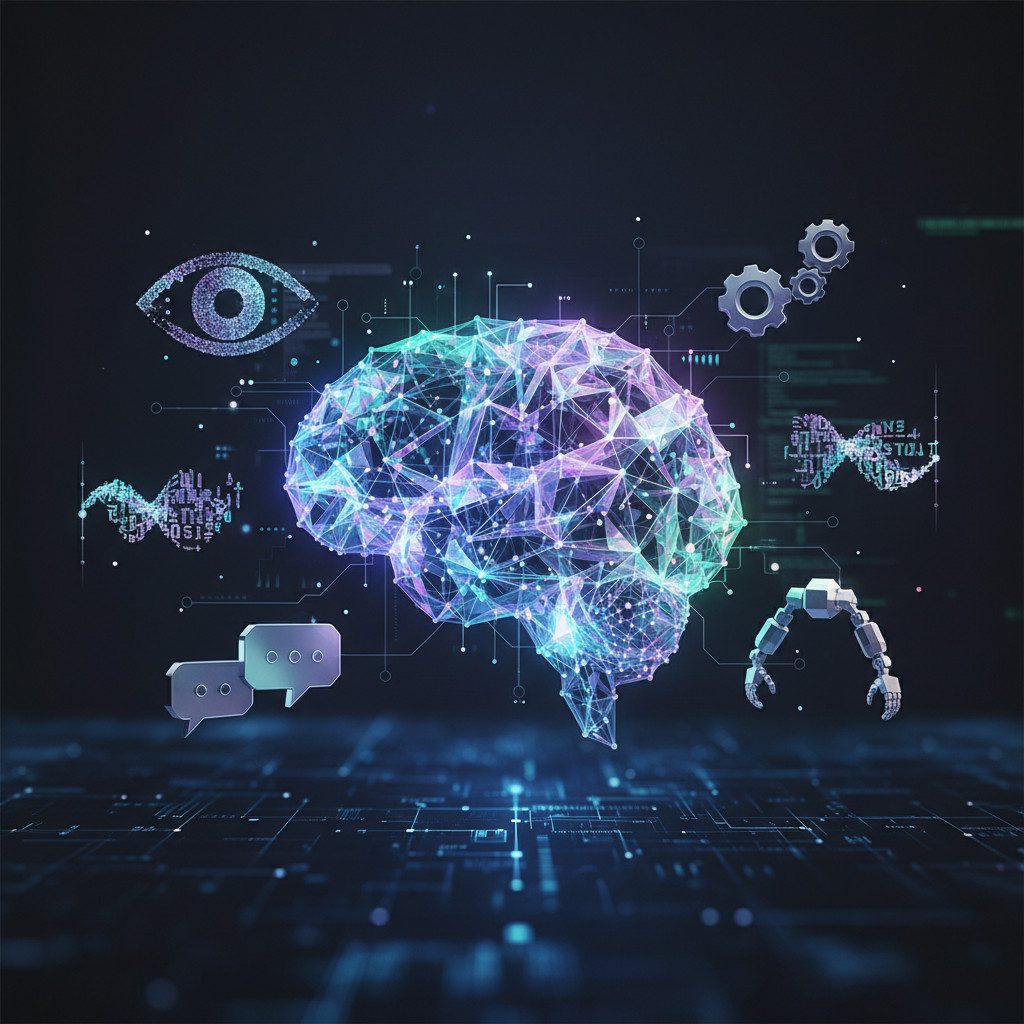

Deep learning is one of the most transformative technologies to emerge from artificial intelligence (AI) research over the past decade. This powerful subset of machine learning has revolutionized fields ranging from healthcare to finance by enabling computers to learn and make decisions based on data without being explicitly programmed. With its roots in neural networks, deep learning algorithms can recognize patterns in large volumes of unstructured data, such as images, sound, and text, with remarkable accuracy.
Understanding Deep Learning
The concept of artificial neural networks (ANNs) dates back to the 1940s when scientists first attempted to model biological neurons mathematically. However, it wasn’t until the advent of powerful GPUs and big data that deep learning truly took off in recent years (investopedia.com). At its core, deep learning involves multiple layers of interconnected nodes or neurons that mimic the human brain’s ability to process information.
Each layer extracts increasingly complex features from raw data until high-level abstractions are formed. For instance, in image recognition tasks, early layers might detect edges and shapes while later ones identify specific objects within scenes (nature.com). This hierarchical structure allows deep learning models to achieve state-of-the-art performance across various domains.
Applications of Deep Learning
One of the most prominent areas where deep learning has made significant strides is computer vision. By leveraging convolutional neural networks (CNNs), researchers can develop algorithms capable of recognizing faces, objects, and even emotions from visual inputs (deeplearningbook.org). This technology powers many consumer-facing applications like facial recognition systems for security or augmented reality filters on social media platforms.
Another exciting application of deep learning lies in natural language processing (NLP). Recurrent neural networks (RNNs) and transformers have enabled machines to understand, generate, and translate human languages with unprecedented fluency. Chatbots powered by these models can engage users in meaningful conversations while predictive text features enhance typing experiences on smartphones (aws.amazon.com).
Challenges and Limitations of Deep Learning
Despite its impressive capabilities, deep learning also faces several challenges that hinder widespread adoption. One major issue is the need for vast amounts of labeled training data, which can be time-consuming and expensive to obtain (ibm.com). Moreover, deep learning models tend to require substantial computational resources during both training and inference phases.
Another concern revolves around interpretability. The intricate nature of neural networks often makes it difficult for humans to understand why certain predictions were made or how decisions are reached internally (nature.com). This lack of transparency can be problematic in fields like medicine where patient safety is paramount.
Future Directions for Deep Learning
The future of deep learning looks promising as researchers continue to innovate and refine existing techniques. One area of active research focuses on developing more efficient architectures that reduce computational requirements while maintaining accuracy (deeplearningbook.org). Another direction involves exploring novel approaches like generative adversarial networks (GANs) and reinforcement learning to tackle increasingly complex problems.
Generative Adversarial Networks (GANs)
GANs consist of two neural networks pitted against each other in a zero-sum game. The generator network creates synthetic data samples while the discriminator evaluates them for authenticity (nature.com). Through repeated iterations, both networks improve until the generated outputs become indistinguishable from real ones.
Reinforcement Learning
In contrast to supervised learning where correct answers are provided during training, reinforcement learning teaches agents through trial-and-error interactions with an environment. By receiving rewards or penalties based on their actions, agents learn optimal policies over time (ibm.com). This paradigm is particularly useful for tasks involving decision-making under uncertainty.
Conclusion: TL;DR
In summary, deep learning has proven to be a game-changer in the realm of artificial intelligence. Its ability to process complex data and extract meaningful insights from unstructured sources opens up endless possibilities across diverse industries. However, it is crucial for practitioners to remain aware of associated challenges and limitations while embracing ongoing advancements.