
The world of artificial intelligence (AI) and machine learning (ML) is constantly evolving, offering endless opportunities and challenges to professionals in the tech industry. While these terms are often used interchangeably, they represent different aspects of a broader spectrum that includes neural networks, deep learning, natural language processing, text mining, and clustering. In this article, we will delve into the nuances of AI vs ML, providing a comprehensive guide for data scientists, machine learning engineers, software engineers, and students transitioning into these fields.
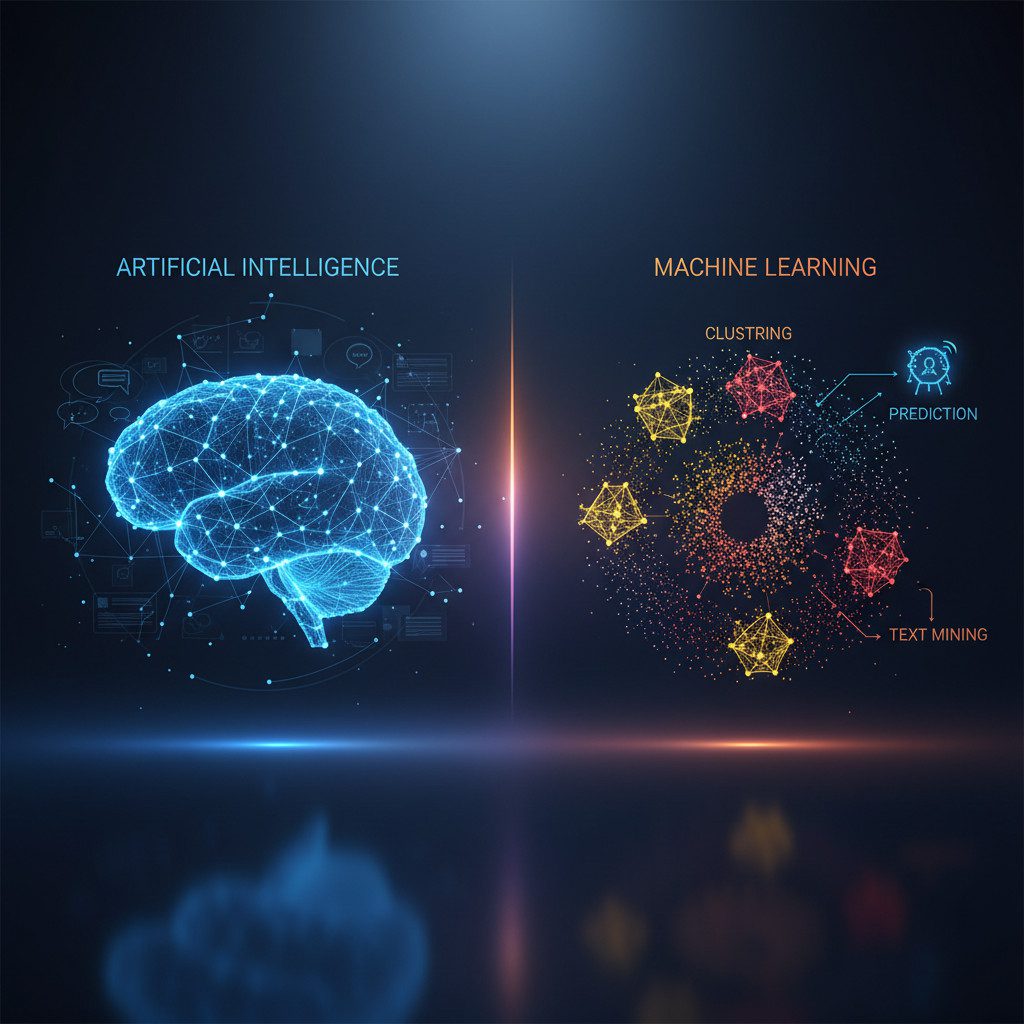
Artificial intelligence is a broad term that encompasses any technique or algorithm designed to mimic human cognition. This includes everything from simple decision-making algorithms to complex systems capable of understanding natural language and performing tasks like driving a car autonomously. Machine learning, on the other hand, is a subset of AI focused specifically on using statistical techniques to enable computers to learn patterns in data without being explicitly programmed.
In this article, we will break down these concepts, discuss their applications, and highlight key differences to help you navigate the ever-changing landscape of AI and ML. Whether you are just starting your journey into machine learning or looking to deepen your understanding of advanced topics like deep learning, this guide is for you.
The Fundamentals of Artificial Intelligence (AI)
Artificial intelligence refers to a broad range of technologies designed to simulate human cognitive functions. These include perception, reasoning, problem-solving, knowledge representation, planning, and natural language understanding. AI systems are used in various industries such as healthcare, finance, retail, and manufacturing.
A key aspect of AI is its ability to automate tasks that would traditionally require human intelligence. For example, AI can analyze large datasets, recognize patterns, and make predictions based on data-driven insights. This capability has led to the development of applications like chatbots for customer service, recommendation engines in e-commerce platforms, and autonomous vehicles.
However, it’s important to note that not all AI systems rely solely on machine learning techniques. Some older methods, such as rule-based expert systems, use a different approach where rules are defined by human experts rather than learned from data.
The Role of Machine Learning (ML)
Machine learning is a critical component within the broader field of AI. It involves developing algorithms that allow computers to learn patterns and make predictions based on historical data. Unlike traditional programming, where rules are explicitly written by humans, ML systems infer these rules from examples.
Much of today’s cutting-edge technology relies heavily on machine learning techniques. For instance, recommendation engines in streaming services like Netflix use collaborative filtering algorithms that recommend content based on user behavior patterns. These models continuously learn and adapt as new data becomes available.
Machine learning can be broadly classified into three categories: supervised learning, unsupervised learning, and reinforcement learning. Supervised learning involves training a model using labeled datasets, while unsupervised learning aims to find hidden structures in unlabeled data. Reinforcement learning focuses on teaching machines how to make decisions through trial and error.
Understanding Neural Networks
Neural networks are among the most powerful tools in modern machine learning. Inspired by the structure of biological neurons, artificial neural networks (ANNs) consist of layers of interconnected nodes that process information hierarchically. These networks can model complex non-linear relationships and have been instrumental in advancements like computer vision and speech recognition.
Deep learning is a subset of machine learning that focuses on multi-layered neural networks called deep neural networks (DNNs). DNNs can automatically learn feature representations from raw data, making them highly effective for tasks such as image classification and natural language processing. However, training these models requires significant computational resources.
Popular frameworks like TensorFlow and PyTorch provide tools to build and train neural network models efficiently. These platforms support various architectures including convolutional neural networks (CNNs) for computer vision applications and recurrent neural networks (RNNs) for sequence prediction tasks.
Natural Language Processing (NLP)
Natural language processing combines linguistics, machine learning, and AI to enable computers to understand human language. NLP techniques are used in various applications ranging from sentiment analysis on social media platforms to chatbots that interact with customers in natural conversations.
Key components of NLP include tokenization (breaking text into words), part-of-speech tagging, named entity recognition, and semantic parsing. Advanced models like transformers have significantly improved the accuracy of these tasks by leveraging attention mechanisms that focus on relevant parts of input sequences.
The future of NLP looks promising with ongoing research in areas such as multimodal learning (combining text with images or audio) and zero-shot learning (making predictions without prior training data). These advancements are expected to bring more intuitive and context-aware systems into everyday use.
Text Mining and Clustering
Text mining involves extracting valuable information from unstructured textual documents using techniques like topic modeling, sentiment analysis, and keyword extraction. This process is crucial for businesses seeking insights from large volumes of customer feedback or social media posts.
Data clustering is another essential technique in machine learning that groups similar data points together based on certain characteristics. It helps identify patterns within datasets without predefined labels. Common algorithms used for clustering include k-means and hierarchical clustering.
Both text mining and clustering play a vital role in various industries, enabling organizations to gain actionable insights from unstructured data sources. For example, retail companies can use text mining to understand customer preferences through product reviews, while healthcare providers might employ clustering techniques to segment patients for targeted interventions.
Tl;dr
In summary, artificial intelligence and machine learning are interconnected yet distinct fields within the tech industry. AI encompasses a wide range of technologies designed to simulate human cognition, whereas ML focuses specifically on algorithms that enable computers to learn from data. Neural networks, deep learning, natural language processing, text mining, and clustering represent key areas where these concepts come together.
Understanding the nuances between these domains is crucial for professionals in data science and machine learning engineering. By leveraging advanced techniques like neural networks and NLP, you can develop intelligent systems that provide real-world value across various industries. As technology continues to evolve, staying informed about emerging trends will be essential for success in this dynamic field.